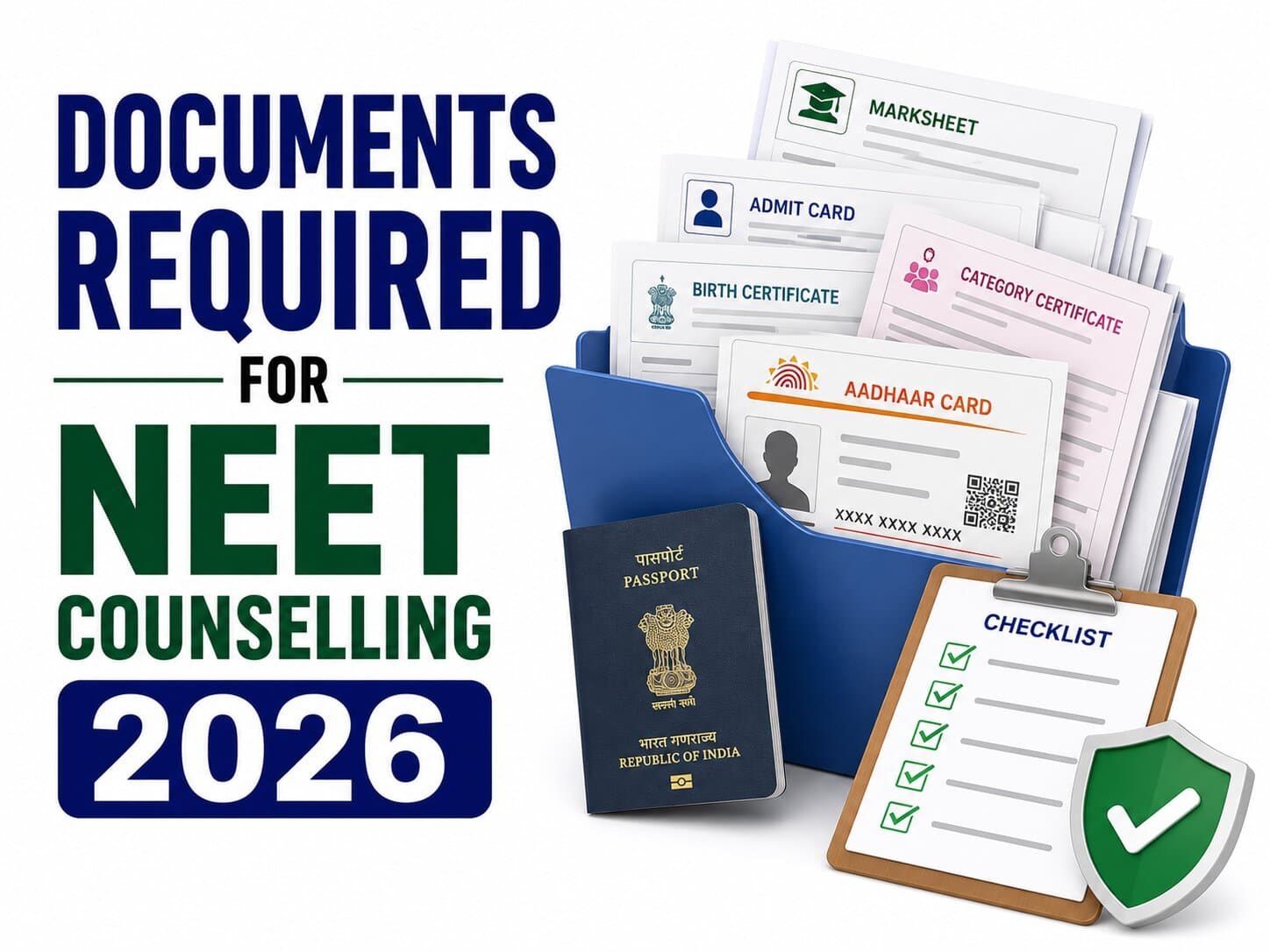
The NEET UG 2026 result has been declared. For qualified candidates, the next major step is counselling — and what separates students who sail through document verification from those who lose confirmed seats at the last stage is preparation. Every year, candidates with strong ranks and valid allotments lose their MBBS seats because a certificate is in the wrong format, a category document has expired, or a name on one paper does not match another. These are not difficult mistakes to make. They are also not difficult to avoid, provided you know exactly what is needed before reporting day.
Before diving into what to carry, it helps to understand how NEET counselling document verification actually works. When you appear for document verification — either online through the MCC portal or physically at the allotted college — the documents you submit are checked against your NEET application. Every name, every date, every certificate detail must match. Any discrepancy can trigger rejection at the reporting counter, and that rejection, in most cases, is final for that round.
The documents required for NEET counselling fall into four distinct groups: universal documents that every candidate must carry regardless of category or quota, category-specific certificates for reserved category candidates, state quota additional documents for candidates using WBMCC or other state authorities, and NRI or OCI documents for candidates applying under those quotas. This article covers all four groups in full. For a quick-reference version, the NEET counselling documents checklist 2026 is also available as a standalone resource.
Why Getting Documents Right Matters More Than You Think
Before understanding how NEET counselling works at the document level, one fact is worth absorbing clearly: document verification is conducted by the college, not by MCC. MCC allocates the seat. The college verifies whether you deserve to keep it. If the college finds a problem at the reporting counter, they report it to MCC and the seat is cancelled. By then, the counselling window for that round may already be closed.
This is different from other stages of the admission process where errors can be corrected through the portal. The document verification stage has no edit window. The moment an original is rejected at the counter, your options narrow dramatically. Getting everything right before you walk in is not optional.
Candidates who have already reviewed the NEET 2026 result and their scorecard know their All India Rank and category rank — those two numbers determine which counselling authority and which quota you fall under, which in turn determines exactly which documents you need.
Group 1: Universal Documents — Required by Every Candidate
These documents are mandatory regardless of category, quota, or course. Whether you are appearing under MCC AIQ, WBMCC state quota, deemed university counselling, or any state counselling authority, you must carry all of the following:
NEET UG 2026 Admit Card The admit card issued by NTA is proof that you appeared for the Re-NEET examination on June 21, 2026. It is required at every stage of counselling and document verification. Download it from neet.nta.nic.in using your application number and password.
NEET UG 2026 Scorecard / Rank Letter The scorecard contains your marks, percentile, All India Rank, category rank, and qualifying status. This is the foundation document of the entire counselling process — your eligibility, your merit position, and your category rank are all read from it. Carry both a digital backup and at least four printed copies. The NEET UG 2026 state-wise qualified candidates data gives useful context on where competition is concentrated, which affects how competitively different counselling rounds play out.
MCC or State Allotment Letter After seat allotment, you must download the provisional allotment letter from the MCC portal (mcc.nic.in) or the respective state counselling portal. This letter is issued per round and must be the one corresponding to your current allotment. Colleges accept only original portal-generated printed copies — screenshots and photographs of the allotment screen are not accepted.
Class 10 Certificate and Marksheet The Class 10 certificate serves as your date of birth proof. The Class 10 marksheet confirms your academic record at the secondary level. Both are required. Every detail on these documents — name spelling, date of birth, father's and mother's names — must exactly match your NEET application. Even a single character difference in a name between documents can create a verification flag.
Class 12 Marksheet and Passing Certificate The Class 12 marksheet confirms your PCB aggregate marks. The minimum is 50% in Physics, Chemistry, and Biology combined for General category candidates, and 40% for SC, ST, OBC, and PwD candidates. The passing certificate confirms that you have successfully completed Class 12 — this is a separate document from the marksheet at most boards. Carry both.
Valid Government-Issued Photo ID Aadhaar card is the most widely accepted and recommended form of photo identification at NEET counselling verification. PAN card, Passport, Voter ID, or Driving Licence are also accepted at most counselling authorities. The name and date of birth on the ID must match your NEET application and academic documents.
Passport-Size Photographs Carry a minimum of 8 to 10 passport-size photographs. These must be identical to the photograph uploaded during your NEET 2026 online registration — same background, same framing, same expression. Photographs are used for multiple forms at the college: the admission form, registration records, identity cards, and institutional copies of your verification documents.
Medical Fitness Certificate A medical fitness certificate must be obtained from a registered MBBS or MD doctor on the specific format prescribed by MCC or the relevant state counselling authority. A general clinic letterhead or a certificate that does not follow the prescribed format is not accepted. The certificate must be recent — issued within the last 60 days from the date of reporting. Confirm the exact format requirement from the official MCC counselling brochure at mcc.nic.in before getting this done.
Group 2: Category-Specific Documents — Reserved Category Candidates
If you are claiming a reserved category seat — OBC-NCL, EWS, SC, ST, or PwD — you must carry the relevant certificate in the precise format specified by the counselling authority. This is where the highest number of verification rejections occur.
For OBC-NCL (Other Backward Classes – Non-Creamy Layer) Candidates
For AIQ seats through MCC, only a Central Government format OBC-NCL certificate is accepted. A certificate issued by your state government in the state's format — even if it is legally valid for state purposes — will be rejected for AIQ counselling. The certificate must confirm that you belong to a caste in the Central OBC list maintained by the National Commission for Backward Classes, and that your family falls in the non-creamy layer.
The most critical validity rule for OBC-NCL certificates: they are valid only for the current financial year. For 2026 admissions, your certificate must be dated on or after April 1, 2026. Any certificate issued before April 1, 2026, regardless of how recently it was obtained, is treated as expired and will result in your being reclassified as a General category candidate at verification — which typically means immediate seat cancellation if the same seat is not accessible to you under General category.
If your OBC-NCL certificate predates April 1, 2026, apply for a fresh one now. The process requires a visit to your Tehsildar or SDM office, and typical processing time is three to seven working days.
For EWS (Economically Weaker Section) Candidates
The EWS certificate must be in the prescribed Central Government format, issued by a competent authority (Tehsildar, SDM, or Revenue Officer), stating that annual family income does not exceed Rs. 8 lakh from all sources. Like OBC-NCL certificates, EWS certificates are valid only for the current financial year — they must be dated on or after April 1, 2026. This is the most frequently forfeited entitlement in NEET counselling: candidates who applied for EWS benefit in previous years and assumed their certificate was still valid, arriving at verification only to be downgraded to General category.
For SC and ST Candidates
Caste certificates for SC and ST generally carry lifetime validity. However, for AIQ seats through MCC, the certificate must be in the Central Government prescribed format. A state-format caste certificate may be accepted for state quota counselling but is not guaranteed to be accepted for MCC AIQ. Carry both formats if you have both. In some states — Maharashtra most notably — a Caste Validity Certificate from the State Caste Scrutiny Committee is also required in addition to the basic caste certificate.
For PwD (Persons with Disability) Candidates
The PwD certificate must be issued by a Medical Board specifically authorised by MCC for this purpose. It must state the nature of disability and explicitly confirm a benchmark disability of 40% or above. PwD certificates from unauthorised sources, certificates that do not specify the disability percentage clearly, or certificates where the disability is assessed at below 40% are rejected. If your PwD certificate is more than five years old, get it reviewed and renewed before counselling begins.
Group 3: State Quota Additional Documents — WBMCC and Other State Authorities
If you are participating in WBMCC counselling for West Bengal's 85% state quota seats — or in any other state's counselling authority — there are additional documents required beyond the universal list. These documents verify your domicile eligibility, which is the basis of the state quota.
Domicile / Residence Certificate This is the most critical additional document for state quota counselling. It establishes that you are a resident of the state and are eligible for state quota seats. The issuing authority is your Tehsildar, SDM, or equivalent competent authority. Absence of this document means disqualification from state quota seats — you cannot substitute another document for a domicile certificate.
Income Certificate Required for candidates applying under EWS quota at state level, for Tuition Fee Waiver categories at certain institutions, and for income-linked scholarship programmes. The income certificate must be from the current year and issued by the same competent authority as the domicile certificate.
State-Format Category Certificates For state quota counselling, SC and ST caste certificates issued in the state's own prescribed format are accepted alongside or in place of central format certificates. Check with WBMCC's official notification whether it specifies central format, state format, or either.
Gap Certificate / Affidavit If you took time off between completing Class 12 and appearing for NEET — even one year — most colleges require a notarised gap certificate on non-judicial stamp paper explaining the reason for the gap. This is prepared by a Notary Public. Get it notarised before reporting day rather than scrambling for a notary on the reporting date itself.
Migration Certificate / Transfer Certificate Required if you completed Class 10 or Class 12 from a school affiliated to a board in a different state from where you are claiming state quota. The migration certificate is issued by your school on behalf of the board. Some state authorities also require it if you transferred between schools or boards during your schooling period.
Character Certificate A character certificate from your school principal or a gazetted officer is required by most institutions at the time of admission. It must be recent — typically within the last six months from the date of reporting.
For West Bengal students navigating both WBMCC and MCC AIQ simultaneously, understanding the complete WBMCC state quota counselling process — including how state merit ranks are calculated and what the domicile requirements are — is essential preparation before either window opens.
Group 4: NRI and OCI Quota Documents
Candidates applying under the NRI or OCI quota at private and deemed universities have additional documentation requirements that must be arranged well in advance, since several involve legal processes with multi-week timelines.
Required documents for NRI/OCI quota candidates include:
OCI card (original) for OCI candidates
Passport and valid visa of the sponsoring NRI relative
Sponsorship affidavit — a notarised declaration by the NRI sponsor confirming they will bear the candidate's full medical education expenses
Relationship affidavit — a notarised document establishing the family relationship between the candidate and the sponsoring NRI
NRI status proof — official documentation confirming the sponsor's NRI status including overseas residence details
All affidavits must be notarised and, where required by the institution, apostilled if executed abroad. Allow four to six weeks for preparation and processing of these documents, particularly where overseas attestation is required.
The Document Preparation Process: How to Organise Before Reporting
Knowing which documents are needed is only half the preparation. The other half is organising them correctly so that the verification process goes smoothly. Verification officers at colleges are processing high volumes of candidates in narrow time windows — a well-organised folder moves faster and makes it easier for officers to confirm your eligibility quickly.
A practical document organisation approach:
Use a multi-pocket plastic sleeve folder with labelled sections for each document category
Keep originals and self-attested photocopies in separate sections of the folder
Arrange documents in the order specified in the MCC or WBMCC allotment letter and reporting instructions — typically the sequence follows: allotment letter, NEET scorecard, admit card, Class 10 documents, Class 12 documents, ID proof, category certificates, photographs, medical fitness certificate
Make three sets of self-attested photocopies of every document — one for online upload, one for the college, one as a retained backup
Save scanned digital copies of all documents in cloud storage accessible from your phone
Print a minimum of 10 passport-size photographs before reporting day — they are used across multiple forms
The most important cross-check before leaving for reporting: ensure every name across every document is consistent. Your name as it appears on your NEET application, your Class 10 certificate, your Aadhaar card, and your category certificates must be identical character by character. If there is a legitimate discrepancy — for example, an older transliteration of your name on one document — resolve it at the issuing authority before reporting day. This takes time, so start now.
Documents Required for Online Upload During MCC Registration
Before physical reporting, MCC requires candidates to upload scanned documents online during the registration and choice-filling phase. The online upload is a preliminary check — it does not replace physical verification, but documents rejected online can prevent progression to the next counselling stage.
Documents typically required for online upload at mcc.nic.in include:
Passport-size photograph (JPG, within specified size limits — typically 10kb to 200kb)
Signature (JPG, within specified size limits)
NEET UG 2026 scorecard
Class 10 marksheet
Class 12 marksheet
Category certificate (OBC-NCL, EWS, SC, ST, or PwD) if applicable
Scan all documents at a resolution that makes text clearly readable while keeping the file within the specified size limit. Poor-quality scans — too dark, too light, blurred, or cut off at the edges — are rejected by the portal's validation system. Prepare all scanned files in the correct format before the registration window opens. Trying to scan and resize files on registration day under time pressure frequently leads to format errors.
Common Mistakes That Lead to Seat Cancellation
Every counselling cycle, the same categories of errors result in students losing seats. Understanding them before verification is the entire point of advance preparation.
Expired OBC-NCL or EWS certificate. This is the most common and most preventable rejection. Both certificates must be dated after April 1, 2026. There is no exception, no grace period, and no appeal process at the reporting counter. If your certificate is from the previous financial year, get it renewed immediately.
State-format OBC certificate submitted for AIQ seats. MCC requires the Central Government format for OBC-NCL certificates for AIQ counselling. A state-issued OBC certificate is not a substitute. Students who arrive with a state certificate for an AIQ allotment are reclassified as General category candidates on the spot.
Name mismatch across documents. A candidate whose Aadhaar reads "Mohammad" while their Class 10 reads "Mohammed" creates a verification flag that the officer must escalate. These transliteration differences feel trivial but cause real delays. Resolve them before reporting.
Medical fitness certificate in wrong format. A certificate on a general clinic letterhead without the MCC-prescribed fields completed, or signed by a doctor without their NMC registration number, is rejected. Use the exact format specified in the MCC information brochure.
Laminated original certificates. Some verifying officers cannot apply official stamps or inspect security features on laminated documents. Newer certificates should be kept unlaminated. If an original has been laminated and you have no unlaminated copy, contact the issuing board for a re-issue before reporting.
Forgetting to carry the allotment letter. The provisional allotment letter must be printed from the official portal after each round. It cannot be reconstructed from a screenshot. If you close the window without printing, log back in and reprint before leaving for reporting.
What Happens If a Document Is Missing at Reporting
If you arrive at the reporting counter and a required document is missing — even one — you have limited options. In most cases, the college will not admit you that day. Whether they allow you to return with the document within the same reporting window depends entirely on the institution's policy and the remaining days in that window. Some colleges allow a 24-hour grace period for minor missing documents. Others do not.
In practice, the safest approach is to treat every document on the list as equally mandatory. There is no "most important" document versus a "less important" one — any missing document is enough to create a problem at verification. Understanding what a good NEET counselling platform should actually offer — including pre-verification document review — helps candidates choose the right support structure before reporting day.
For students who want expert guidance on preparing for document verification — knowing which formats are required for their specific category, quota, and allotment authority — structured counselling support that covers the documentation stage specifically is far more efficient than piecing together information from scattered sources. The complete college admission counselling support framework covers exactly this kind of stage-specific guidance, from document preparation through to final reporting.
Scholarship Documentation: What to Prepare Alongside Admission Documents
The counselling period is also when most scholarship application windows open. For West Bengal students pursuing MBBS, the Swami Vivekananda Merit Cum Means Scholarship provides annual support of up to Rs. 60,000 for eligible students at recognised institutions. Applications typically open alongside admission confirmations, and the documentation required overlaps significantly with admission documents — income certificate, category certificate, marksheets, and institution confirmation letter.
Preparing scholarship documentation alongside admission documents in the same window is significantly more efficient than returning to the same government offices twice. If you know you are eligible for SVMCM or any other scheme, initiate the scholarship application simultaneously with your admission document preparation.
The Counselling Process Around Your Documents
Understanding where documents are required across the full counselling journey — not just at the final reporting stage — helps candidates prepare systematically rather than reactively.
Documents are needed at three distinct points: online during MCC or state counselling registration, online again during document upload after allotment confirmation, and physically at the allotted college during final reporting. The online upload stages serve as a pre-check. They do not replace originals. The physical stage is final.
For students who want a deeper understanding of how mop-up and stray vacancy rounds change the document landscape — particularly which new allotment letters are required and what the tighter reporting windows in later rounds mean for document preparedness — the explanation of how mop-up and stray vacancy rounds work covers those specific stage dynamics in detail.
The NEET 2026 answer key and OMR evaluation guide — which has seen over 4 lakh impressions — is another useful reference for candidates who are still in the earlier stages of their counselling preparation and want to cross-verify their score before finalising their document preparation based on expected rank.
Sector-Specific Documents: MBBS, BDS, AYUSH, and Deemed Universities
The core document list above applies to MBBS, BDS, and AYUSH admissions through MCC and state authorities. Deemed universities — which are covered under the MCC's separate deemed university counselling process — may have additional institution-specific requirements beyond the standard MCC list. These typically include:
Institution-specific application forms available on the college's portal
Anti-ragging affidavit (mandatory at all NMC-recognised institutions, signed by both candidate and parent/guardian)
Gap certificate if applicable
Domicile certificate in some cases even for deemed university admissions
Always download and read the official counselling brochure for the specific institution you are reporting to, alongside the main MCC information bulletin. Deemed university requirements can vary from one institution to another.
Students considering paramedical courses alongside or instead of MBBS should note that SMFWBEE 2026 paramedical admissions run on an entirely different admission calendar with their own document requirements — some of which overlap with the standard list above, and some of which are specific to the WBMCC-adjacent process. Engineering aspirants who are navigating JEE counselling step by step in parallel with NEET will find that many of the same category certificate rules — particularly OBC-NCL format and EWS validity requirements — apply equally to JoSAA document verification.
Quick Reference: Documents Checklist Before You Leave for Reporting
Before leaving for physical reporting at any college, run through this sequence. For additional counselling guidance, the counselling blog section regularly publishes updated resources on every stage of NEET counselling:
Universal documents (all candidates):
NEET UG 2026 Admit Card
NEET UG 2026 Scorecard / Rank Letter
Provisional Allotment Letter (current round, printed from portal)
Class 10 Certificate and Marksheet
Class 12 Marksheet and Passing Certificate
Valid Photo ID (Aadhaar preferred)
Passport-size photographs (minimum 8–10 copies)
Medical Fitness Certificate (MCC/state prescribed format)
If claiming reserved category:
OBC-NCL Certificate (Central format, dated after April 1, 2026)
EWS Certificate (Central format, dated after April 1, 2026)
SC/ST Caste Certificate (Central format for AIQ; state format for state quota)
PwD Certificate (from MCC-authorised Medical Board, 40%+ disability stated)
Caste Validity Certificate (if required in your state — mandatory in Maharashtra)
State quota additional (if applicable):
Domicile / Residence Certificate
Income Certificate (if applicable)
Gap Certificate / Affidavit (if gap year taken)
Migration / Transfer Certificate (if applicable)
Character Certificate (within last 6 months)
NRI/OCI (if applicable):
OCI Card
Sponsor's Passport and Visa
Sponsorship Affidavit (notarised)
Relationship Affidavit (notarised)
Carry originals of every document. Carry three sets of self-attested photocopies. Do not carry laminated originals if alternatives exist. Cross-check every name spelling across every document before leaving.
Start Now — Counselling Begins in August
The NEET UG 2026 result is out. MCC counselling for AIQ seats and WBMCC for West Bengal state quota seats are both expected to begin by early to mid-August 2026. The time between now and that window is the last uncompressed period available for document preparation.
For candidates who want to begin the process of understanding which colleges fall within their rank range while simultaneously tracking down their documents, the rank predictor and college predictor tools give a data-driven starting point for building a counselling strategy. Browsing medical colleges listed by state and type helps candidates identify which institutions they are most likely to report to — which in turn clarifies which specific document formats (AIQ or state quota) are most relevant to their preparation. For those who want to understand the full scope of what counselling support covers at each stage — from choice filling through document verification to final reporting — the detailed breakdown of counselling services gives a clear picture of what structured guidance looks like at every stage.
The documents are not an afterthought. They are the final gate. Get them right, and the seat you earn through your NEET rank will be yours.
All document requirements listed in this article are based on MCC's official information bulletins and WBMCC notifications from previous counselling cycles, updated with confirmed 2026 requirements where available. Certificate format specifications, validity rules for OBC-NCL and EWS certificates, and state-specific requirements may be updated in the official 2026 counselling brochure at mcc.nic.in and wbmcc.nic.in. Always verify final document requirements from official sources before appearing for verification.
Article Stats
You Might Also Like
What Is the MS Course? A Complete Guide to Introduction, Eligibility, NEET PG Counselling and Preparation
What Is the MD Course? A Complete Guide to Introduction, Eligibility, NEET PG Counselling and Preparation
Tripura MBBS BDS Round 3 Re-Revised Schedule 2026: Choice Filling, Merit List, Allotment and Admission Dates