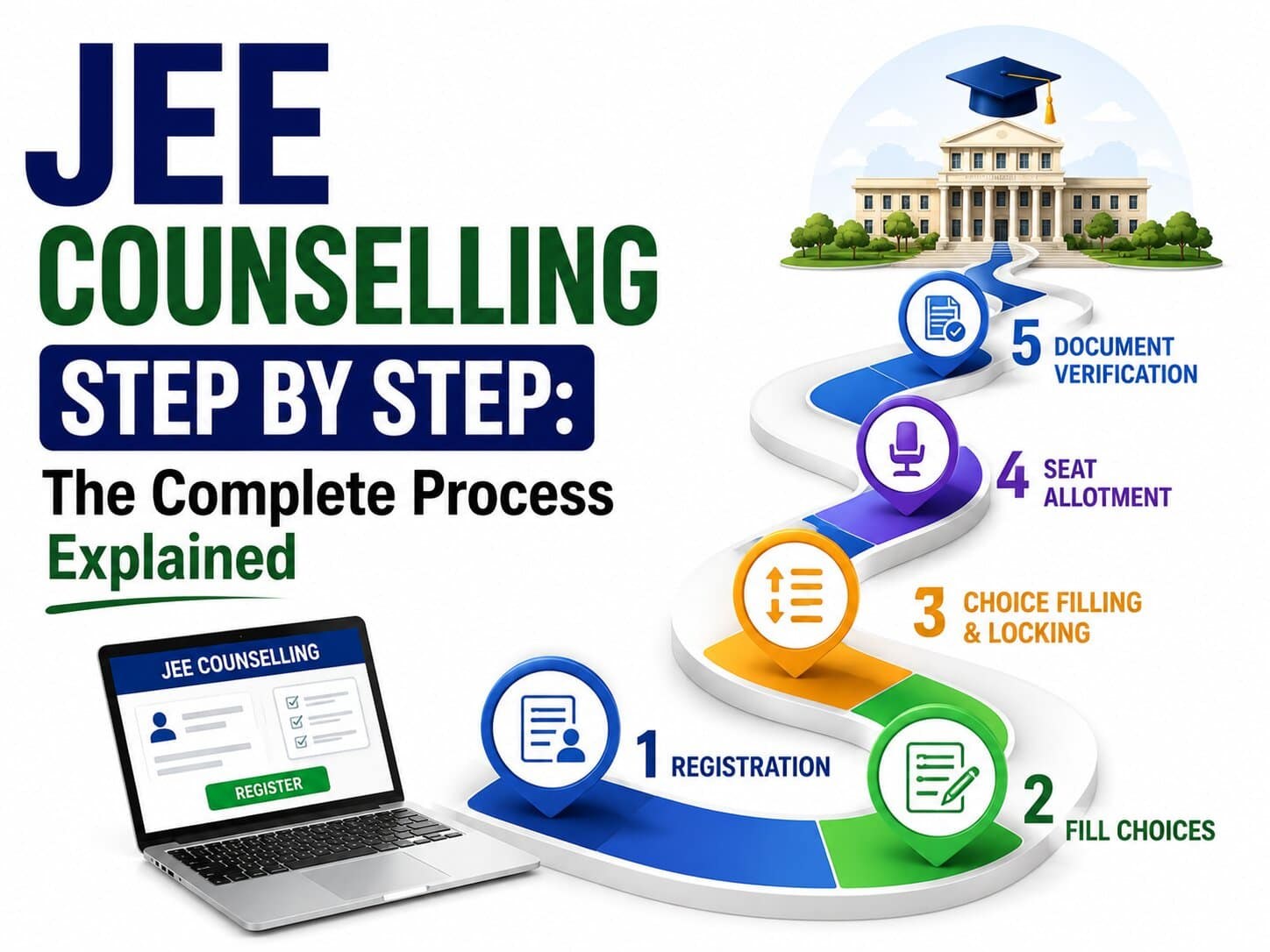
Clearing JEE is only half the journey — the counselling process that follows is where a rank actually turns into a seat, and it trips up far more candidates than the exam itself does. Every year, students with genuinely strong ranks end up with disappointing outcomes simply because they mistimed a registration window, filled too few choices, or misunderstood what "seat acceptance" actually locks them into. This guide walks through JEE counselling step by step, from the moment results are declared to the day a candidate reports at their final institute.
Step 1: Confirm Your Eligibility and Gather Documents Early
Before registration even opens, it's worth confirming exactly which category, quota, and reservation status applies to your application, since this shapes every choice you make later in the process. Category certificates, domicile proof, identity documents, and academic marksheets should all be scanned and ready well before the counselling window opens. Candidates who wait until choice-filling to start hunting for documents often lose valuable early days that could have gone into research instead. Getting a general sense of how counselling registration, choice-filling, and seat allotment mechanics work end to end before your specific process begins makes the entire sequence far less confusing once it actually starts moving.
Step 2: Register Separately for Counselling
This is the single most overlooked step every cycle: qualifying JEE does not automatically enrol you in counselling. Registration for counselling is a distinct process, done on its own portal, after results are declared, and it requires its own set of credentials, personal details, and often a registration fee. Missing this window, even with an excellent rank, simply removes a candidate from that entire round, no exceptions.
Step 3: Pay the Counselling Registration Fee
Once registered, candidates need to pay the applicable counselling fee online, typically through net banking, debit card, or credit card. This fee is generally non-refundable and, in most systems, a single payment covers participation across all subsequent rounds of the same counselling cycle, so there's no need to pay again for each round individually.
Step 4: Research Before You Fill a Single Choice
The choice-filling step is where outcomes are actually decided, and it deserves more preparation time than any other part of the process. Before filling anything, it helps enormously to understand how your rank is likely to translate into realistic institute and branch options, rather than guessing. The underlying logic here mirrors how NEET rank determines realistic college outcomes — in both systems, rank-to-outcome mapping follows a similar pattern, and understanding that pattern before choice-filling changes how realistically a candidate builds their list.
Step 5: Fill and Order Your Choices Carefully
Choices should be listed strictly in order of genuine preference, not in order of perceived "safety." The counselling system attempts to allot the highest-ranked available choice first, based on rank and real-time seat availability, so placing a less-preferred option above a more-preferred one purely out of caution can actually cost a candidate a better outcome. A short choice list narrows your odds considerably, particularly in the very first round when competition is at its peak, so building a genuinely long, well-researched list matters more than most candidates initially assume.
Step 6: Lock Your Choices Only After a Final Review
Once choices are locked, most systems don't allow further edits, which makes the locking step effectively irreversible. It's worth reviewing the full list at least twice, ideally after stepping away and returning with fresh eyes, before finalising anything. Rushed, last-minute locking under deadline pressure is one of the most common regrets candidates report after the fact.
Step 7: Track Seat Allotment on the Official Portal Only
Seat allotment results are released on a fixed date, based entirely on rank, locked choices, and seat availability at that moment. It's worth checking status directly through the official login rather than trusting third-party prediction tools or unofficial forwarded messages, since only the official allotment carries any actual weight.
Step 8: Understand Your Accept, Float, or Slide Options
Once allotted a seat, candidates typically face a choice between a few distinct paths, and picking the right one depends on individual priorities rather than a single "correct" answer. Accepting and freezing a seat ends further participation and locks in that outcome. Floating keeps a candidate in contention for a better allotment in later rounds while holding onto the current seat as a fallback. Sliding allows movement to a different, preferred option within the same participating institutions without risking the seat entirely. Reading the specific options carefully at this stage matters, since terminology and consequences can differ subtly between systems.
Step 9: Pay the Seat Acceptance Fee Promptly
Accepting a seat usually requires paying a seat acceptance or confirmation fee within a specified window, which is often partially or fully adjustable against final admission fees later. Missing this payment deadline after an allotment, even briefly, can result in forfeiting the seat entirely, so this step deserves the same urgency as the choice-filling deadline itself.
Step 10: Complete Document Verification Without Delay
Physical or online document verification confirms that everything submitted during registration matches a candidate's actual records — category certificates, identity proof, academic marksheets, and photographs are typically checked at this stage. Any mismatch or missing document here can genuinely delay admission, which is exactly why gathering these materials early, back in Step 1, pays off the most at this point in the process.
Step 11: Report to the Allotted Institute Within the Window
The final step is physically reporting to the allotted institute within its specified reporting period and completing local admission formalities, including institute-specific fee payment. This is easy to treat as a formality after everything else is done, but missing this final reporting window, even after every earlier step was completed correctly, can still result in losing the seat.
Step 12: Stay Engaged Through Later Rounds if Needed
A disappointing first-round outcome isn't the end of the process. Most JEE counselling systems run multiple rounds, followed by additional rounds for seats that remain vacant after the main allocation cycle. The logic behind this closely resembles how mop-up and stray vacancy rounds function in NEET counselling — unfilled seats don't simply disappear after the first round, they resurface later, often at meaningfully different closing ranks than earlier rounds suggested, which is exactly why staying engaged through the full cycle matters as much as the first-round strategy does.
The Mistakes That Cost Candidates the Most
A handful of avoidable errors show up repeatedly across counselling cycles, and nearly all of them are procedural rather than rank-related:
Assuming exam qualification automatically means counselling registration is complete
Filling an overly short or overly cautious choice list instead of a genuinely researched one
Locking choices in a rush without a final, careful review
Missing a seat acceptance or reporting deadline after already clearing every earlier step
Disengaging from the process entirely after a weak first-round result, instead of tracking later rounds
Planning the Financial Side Alongside the Process
Counselling mechanics are only one half of a complete strategy — the other half is making sure cost doesn't become a last-minute surprise once a seat is actually allotted. It's worth researching institute-wise fee structures early, the same way comparing government and private costs against a state's seat matrix helps clarify affordability well before a final decision is due. If cost is a genuine constraint, checking scholarship eligibility ahead of time changes what's realistically on the table. The Swami Vivekananda Merit-cum-Means Scholarship is a commonly used option worth checking early, alongside the National Scholarship Portal as a broader, centrally-administered scheme, and institute-specific programmes such as the Chanakya University Scholarship for candidates with a particular institute high on their list.
Why Seat Availability Isn't Fixed Year to Year
One detail candidates frequently overlook is that the total number of seats in play can shift meaningfully between cycles, which affects how closing ranks move from one year to the next. Total capacity tends to expand gradually as new institutes and additional intake come online, a pattern visible in how seat counts in West Bengal's medical colleges moved this year — engineering seat matrices follow a broadly similar rhythm of periodic expansion, which is exactly why relying on last year's closing rank as a fixed benchmark can be misleading.
Keeping Track of Parallel Deadlines
Candidates are rarely managing just one entrance process in isolation. It's common to be tracking multiple exam and counselling timelines in the same admission season, and one deadline slipping while attention is on another is a genuinely common failure point. Being aware of how differently individual states and boards structure their own registration windows — the way one recent state counselling registration window opened with a tight, non-negotiable timeline — is a useful reminder that assuming every process follows the same rhythm as the last one you dealt with is a risky habit. Broader context also helps here: knowing how much competition and scale can vary from one region to another puts a candidate's own counselling odds in better perspective than looking at raw rank numbers alone ever could.
Key Things to Remember
JEE counselling moves through twelve broad stages — eligibility and document preparation, separate counselling registration, fee payment, choice research, choice filling, locking, seat allotment tracking, the accept-float-slide decision, seat acceptance fee payment, document verification, final reporting, and staying engaged through later rounds. Most candidates who end up disappointed with their outcome weren't let down by their rank — they were let down by a missed registration window, a rushed choice list, or a skipped deadline somewhere in this sequence. Getting each procedural step right, while separately planning around realistic rank-based expectations, fee structures, and scholarship support, is what actually converts a hard-earned JEE rank into the seat a candidate was aiming for.
This guide reflects the general structure of JEE counselling based on recent admission cycles. Exact dates, fee amounts, and procedural terminology can vary and change year to year — always verify the current schedule and requirements directly on the official counselling portal before taking any action.
Article Stats
You Might Also Like
What Is the MS Course? A Complete Guide to Introduction, Eligibility, NEET PG Counselling and Preparation
What Is the MD Course? A Complete Guide to Introduction, Eligibility, NEET PG Counselling and Preparation

Tripura MBBS BDS Round 3 Re-Revised Schedule 2026: Choice Filling, Merit List, Allotment and Admission Dates