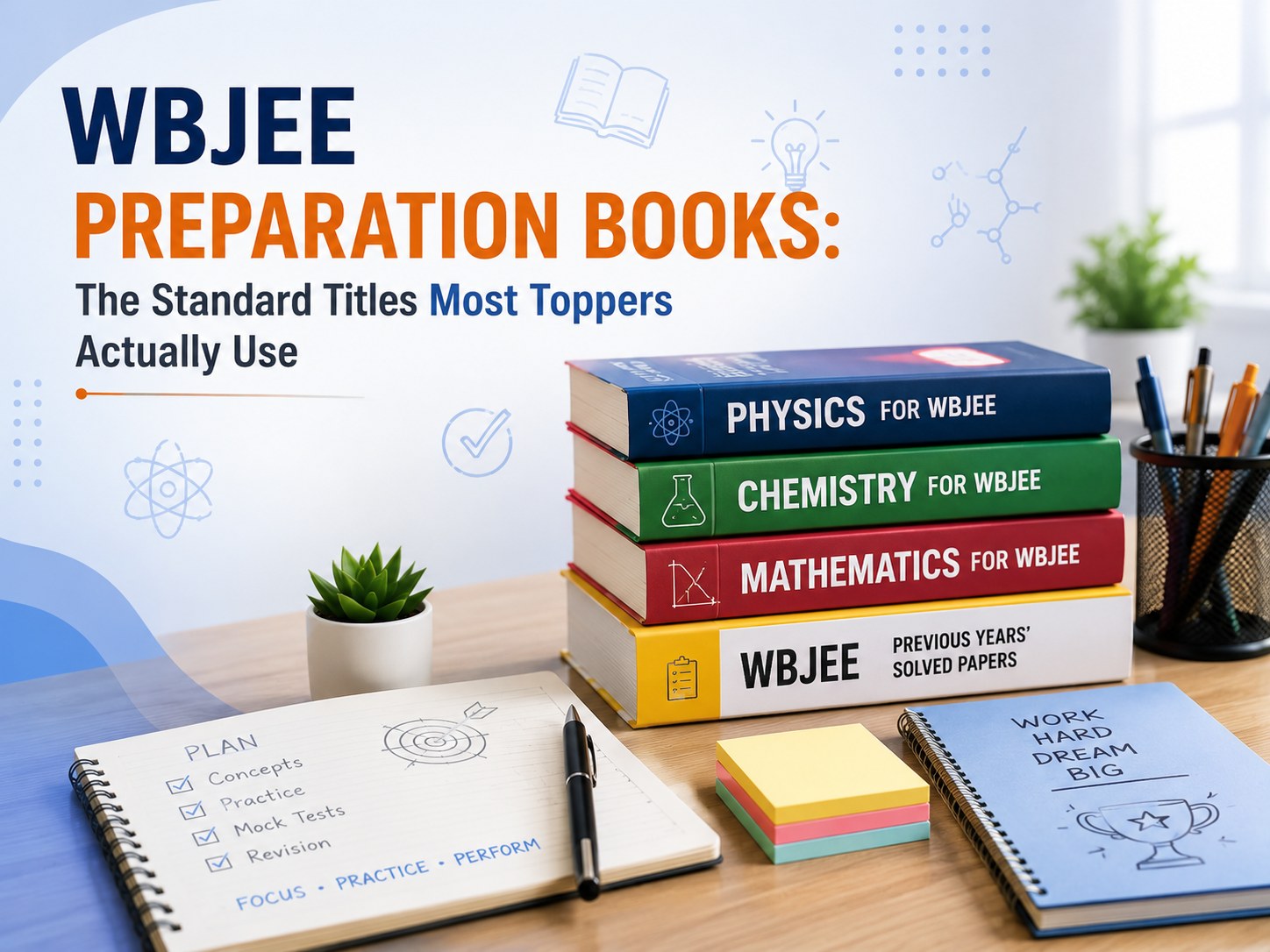
Ask ten WBJEE toppers which books they used, and a handful of names come up again and again - Chhaya Prakashani for board-aligned concept building, S.N. Dey for Mathematics specifically, and Arihant for focused practice. Here's a subject-wise breakdown of the books that consistently show up in WBJEE preparation lists, and how to actually use them together rather than randomly.
Why Book Choice Matters More for WBJEE Than You'd Expect
WBJEE syllabus stays closely tied to the WBCHSE (West Bengal board) curriculum, which is exactly why Chhaya Prakashani titles - written specifically for the WBCHSE syllabus while also covering WBJEE, JEE Main, and JEE Advanced - tend to work unusually well for this exam specifically, in a way that generic all-India JEE books sometimes don't. Layering targeted practice books like Arihant's WBJEE-specific titles on top of that foundation is where most successful preparation strategies land.
Mathematics: Where WBJEE Gets Genuinely Tough
Mathematics is widely considered the most challenging section of WBJEE, tougher and trickier than Physics or Chemistry for most candidates - which makes book choice here especially important.
Mathematics by S.N. Dey (Chhaya Prakashani) is the standard starting point for most WBJEE aspirants in West Bengal. Written specifically according to the WBCHSE syllabus while also covering WBJEE, JEE Main, and JEE Advanced, it includes chapter-wise summaries of key theorems and formulae, a large volume of solved examples, and dedicated MCQ sections for competitive-exam practice. It's considered an excellent book to build fundamentals with, though most serious aspirants pair it with more advanced practice material rather than relying on it alone for the toughest problem types.
For the extra practice layer beyond S.N. Dey, Objective Mathematics by R.D. Sharma and Mathematics by R.S. Aggarwal are frequently recommended for additional problem sets, while candidates aiming for deeper algebra practice sometimes add Higher Algebra by Hall & Knight once the basics are solid.
Physics: Concept Clarity Plus Focused Practice
For Physics, most recommendations start with the NCERT Class 11 and 12 textbooks for core conceptual grounding, followed by more application-focused books. Understanding Physics (D.C. Pandey series) and Arihant's Objective Physics (Volumes 1 & 2) are commonly cited for their extensive solved examples and graded exercises covering the full syllabus. HC Verma's Concepts of Physics, along with solved-problem companion guides, is also widely used for building deeper problem-solving intuition, particularly for numerically heavier chapters.
Chemistry: Splitting Physical, Organic & Inorganic
Chemistry preparation typically works best when split by branch. For Physical and Inorganic Chemistry, O.P. Tandon's titles are among the most consistently recommended, alongside R.C. Mukherjee's Modern Approach to Chemical Calculations for numerical-heavy problem practice. For Organic Chemistry, Arihant's Organic Chemistry title is frequently paired with the NCERT textbooks for building mechanism-level understanding before moving to harder problem sets.
Practice & Previous-Year Papers: The Non-Negotiable Layer
Regardless of which concept books you use, dedicated practice material matters just as much. Arihant's WBJEE Engineering Entrance Exam Solved Papers and Test Drive WBJEE (practice sets with several years of solved papers) are commonly used to get familiar with the exact question style and category-based marking pattern WBJEE uses. MTG's WBJEE Chapter-wise Explorer, covering Physics, Chemistry, and Mathematics together, is another frequently cited option for topic-wise practice.
Solving previous years' papers specifically matters for WBJEE because of its distinct Category 1/2/3 marking structure — a skill that generic all-India JEE practice books don't always train for directly, since they're built around a different marking scheme entirely.
What to Do With This List
Don't try to use every book listed here - preparation quality comes from consistent use of a smaller, well-chosen set of books, not from accumulating as many titles as possible.
Start with your board-aligned concept books (like S.N. Dey for Mathematics or NCERT for Physics and Chemistry) to build fundamentals, then layer in one focused practice book per subject once your concepts are solid, rather than jumping straight to advanced practice material.
Dedicate a consistent daily block specifically to previous-year WBJEE papers and category-wise practice sets, since these train you on the exact question style and marking scheme you'll face - something concept books alone don't fully replicate.
Check that you're using the latest edition of whichever books you choose, since syllabus alignment and question patterns get updated periodically, and older editions can carry content no longer on the current syllabus.
Key Things to Remember
Chhaya Prakashani's S.N. Dey Mathematics is the standard starting point for WBJEE Maths among West Bengal candidates, valued for its direct WBCHSE syllabus alignment.
WBJEE Mathematics is widely considered the toughest section — pairing S.N. Dey with an advanced practice book like R.D. Sharma or R.S. Aggarwal is a common strategy.
Arihant's WBJEE-specific solved papers and practice sets are the most frequently recommended resource for getting used to the exam's actual question style and category-based marking.
Quality and consistency in using a focused set of books matters more than the total number of books you own.
Article Stats
You Might Also Like
What Is the MS Course? A Complete Guide to Introduction, Eligibility, NEET PG Counselling and Preparation
What Is the MD Course? A Complete Guide to Introduction, Eligibility, NEET PG Counselling and Preparation
Tripura MBBS BDS Round 3 Re-Revised Schedule 2026: Choice Filling, Merit List, Allotment and Admission Dates