 All Articles
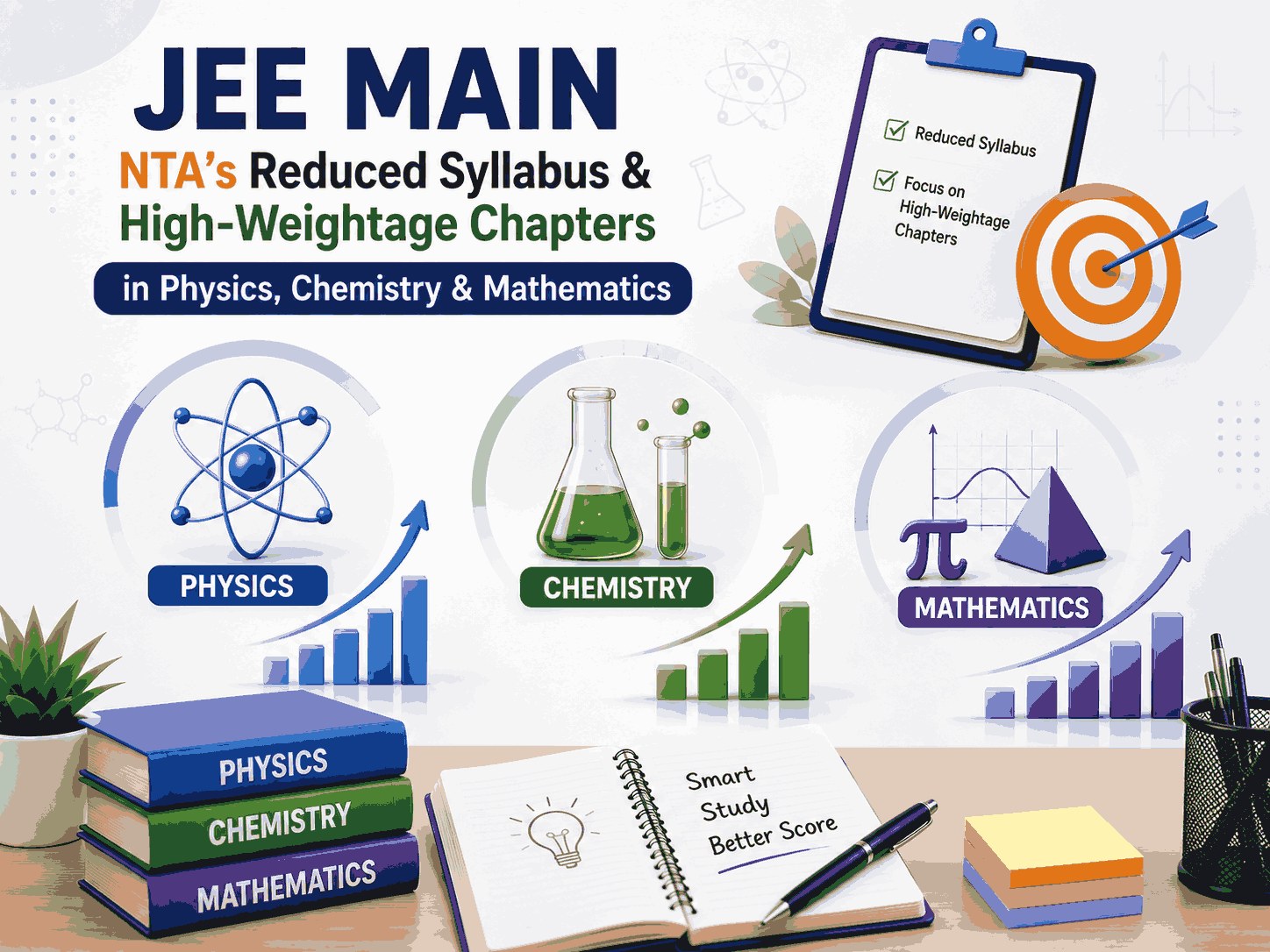
JEE Main: NTA's Reduced Syllabus & High-Weightage Chapters in Physics, Chemistry & Mathematics
Two questions dominate JEE Main preparation strategy every year: what's actually still on the syllabus, and among what remains, which chapters deserve the most attention. Here's an updated look at both.
The Reduced Syllabus: Where Things Stand
NTA's major syllabus reduction was carried out back in 2024, removing roughly 15% of content across Physics, Chemistry, and Mathematics to better align the exam with the core NCERT curriculum. That reduced structure has continued largely unchanged through 2025 and into 2026, with no fresh large-scale deletions announced for the current cycle.
As a quick recap: Physics lost the Communication Systems unit entirely, along with Capacitors and Capacitance, parts of Optics, and select subtopics within Semiconductors and Radioactivity, while basic vector concepts were also dropped since they're already covered under Mathematics. Chemistry lost full chapters - States of Matter, Surface Chemistry, Environmental Chemistry, and Polymers - along with parts of Organic Chemistry and detailed group-wise study of P-Block elements. Mathematics lost Mathematical Induction and Mathematical Reasoning as complete units, along with select topics within Three-Dimensional Geometry.
The practical implication for 2026 aspirants: the syllabus you're preparing from is stable, but it's worth cross-checking your study material and question banks against the current official syllabus PDF, since a lot of older resources still include content that's no longer tested.
High-Weightage Chapters: Why They Matter
NTA doesn't officially publish a chapter-wise weightage breakdown, but detailed analysis of the last several years' papers shows a consistent pattern — a relatively small set of chapters account for a disproportionately large share of the questions asked. Understanding this isn't about skipping the rest of the syllabus; it's about knowing where to concentrate your practice time for the best return.
Physics: What Consistently Scores
Current Electricity has consistently been among the highest-weightage chapters in Physics, typically contributing 2-3 questions per paper and valued for being largely formula-based and predictable. Ray Optics and Optical Instruments follows closely, usually conceptual with diagram-based questions. Electrostatics - covering electrostatic potential and capacitance - also features prominently, often numerical in nature.
Beyond these, Modern Physics (covering Dual Nature of Radiation and Matter, and Atoms and Nuclei) shows up consistently across sessions, and together with Mechanics and Electromagnetism, these topics account for a major share of the Physics section. Thermodynamics and Laws of Motion round out the list of chapters worth prioritizing early in your revision.
Chemistry: Where the Marks Concentrate
Chemistry tends to be the most evenly balanced of the three subjects, but a few areas still stand out. Coordination Compounds is consistently one of the highest-weightage chapters, alongside Aldehydes, Ketones, and Carboxylic Acids from Organic Chemistry. Hydrocarbons and Periodic Table-related topics from Inorganic Chemistry also carry substantial weight.
On the Physical Chemistry side, Stoichiometry, Chemical Equilibrium, and Thermodynamics tend to be heavily tested, while s-Block and p-Block elements dominate the Inorganic portion. Chapters like Solutions, Surface Chemistry-adjacent topics, and Metallurgy generally carry comparatively lower weightage, making them reasonable to deprioritize slightly if your revision time is limited.
Mathematics: The Calculus-Heavy Core
Mathematics shows the clearest concentration of all three subjects - Calculus alone, spanning Limits, Continuity and Differentiability, Definite Integration, and Applications of Derivatives, accounts for a substantial share of the Mathematics section on its own. Combined with Algebra, these two areas together make up the majority of Mathematics questions in a typical paper.
Coordinate Geometry, including Conic Sections (Parabola, Ellipse, Hyperbola), is another consistently high-weightage area, along with Matrices and Determinants, and Three-Dimensional Geometry. Sequence and Series, and Straight Lines, from the Class 11 portion, also feature reliably across sessions.
What This Means for Your Preparation
Build your revision schedule around the high-weightage chapters identified above first, then work outward to the rest of the syllabus — this maximizes your score-per-hour-of-study rather than treating every chapter with equal urgency.
Don't neglect lower-weightage chapters entirely, since previous-year papers show that these often contain more straightforward, quick-scoring questions precisely because they're not the focus of most candidates' preparation.
Solve chapter-wise previous-year questions specifically for the high-weightage areas identified here, since question patterns within these chapters tend to repeat in structure even when the exact numbers change from session to session.
Cross-check any weightage list - including this one - against the most recent 2-3 sessions' actual question papers where possible, since chapter emphasis can shift gradually year to year even without formal syllabus changes.
Key Things to Remember
The major NTA syllabus reduction happened in 2024 and has remained largely stable through 2025 and 2026, with no significant fresh deletions this cycle.
In Physics, Current Electricity, Ray Optics, Electrostatics, and Modern Physics are consistently high-weightage.
In Chemistry, Coordination Compounds, Organic Chemistry reactions, and core Physical Chemistry topics like Chemical Equilibrium and Thermodynamics dominate.
In Mathematics, Calculus and Coordinate Geometry together account for the largest share of questions, making them the single highest-priority area across all three subjects.
Chapter-wise weightage is based on historical analysis, not an official NTA release — treat it as a preparation guide, not a guarantee.
This article is based on analysis of recent JEE Main papers and NTA's officially released syllabus. Chapter-wise weightage figures are estimates derived from past-year trends and can shift slightly each session - candidates should verify the current syllabus against the official document on jeemain.nta.nic.in and supplement this analysis with their own review of recent question papers.
Article Stats
You Might Also Like
What Is the MS Course? A Complete Guide to Introduction, Eligibility, NEET PG Counselling and Preparation
What Is the MD Course? A Complete Guide to Introduction, Eligibility, NEET PG Counselling and Preparation
Tripura MBBS BDS Round 3 Re-Revised Schedule 2026: Choice Filling, Merit List, Allotment and Admission Dates