WBJEE remains one of the few major engineering entrance exams in India that's still conducted offline, and its category-based marking scheme trips up a lot of first-time aspirants. Here's a clear breakdown of how the exam is structured and exactly how each category of question is marked.
WBJEE Exam Structure at a Glance
WBJEE is conducted as a pen-and-paper test using OMR sheets, available in both English and Bengali. The exam is split into two compulsory papers - Paper I covering Mathematics, and Paper II combining Physics and Chemistry in equal proportion. Both papers must be attempted for engineering and pharmacy admission; appearing only in Paper I limits a candidate's eligibility to a narrower set of courses.
Each paper runs for 2 hours, with both papers held on the same day and separated by a 1-hour break, bringing total exam time to 4 hours. Across both papers combined, candidates attempt 155 questions for a total of 200 marks - Paper I carries 100 marks over 75 questions, and Paper II carries 100 marks over 80 questions, split evenly between Physics and Chemistry.
Understanding the Three Question Categories
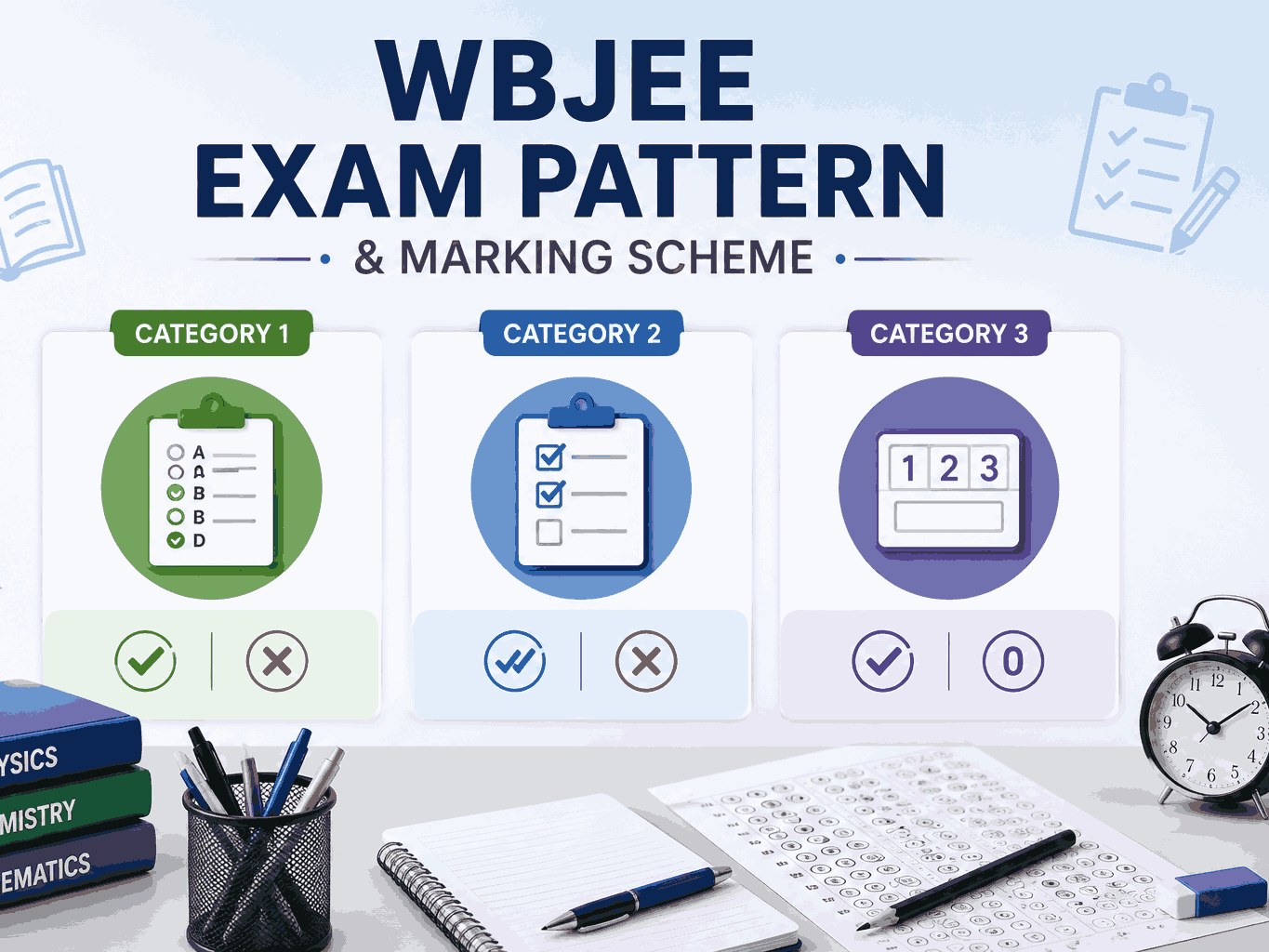
Every subject in WBJEE — Mathematics, Physics, and Chemistry — follows the same three-category structure, differentiated by question type, marks awarded, and negative marking rules.
Category 1 questions have only one correct option among the choices given. Each question in this category carries 1 mark, with a penalty of -¼ mark for every wrong answer. This category typically makes up the bulk of the paper, so accuracy here matters more than in any other section, since guessing carries a real cost.
Category 2 questions also have only one correct answer, but carry a higher weight of 2 marks each. The negative marking penalty is steeper too — typically -½ mark for a wrong answer, roughly double the penalty of Category 1. This makes Category 2 the section where candidates need to be genuinely confident before attempting a question, since a wrong guess costs more here than anywhere else in the paper.
Category 3 questions are multiple-correct-answer questions, where one or more of the given options may be correct. Each question carries 2 marks, and crucially, there is no negative marking at all for wrong answers in this category. This is a meaningful strategic advantage — since there's no penalty for an incorrect attempt, candidates should never leave a Category 3 question unattempted, even under partial confidence.
How This Breaks Down Paper-Wise
In Paper I (Mathematics), the 75 questions are typically distributed as 50 Category 1 questions worth 1 mark each, 15 Category 2 questions worth 2 marks each, and 10 Category 3 questions worth 2 marks each — adding up to 100 marks. Paper II (Physics & Chemistry) follows the same three-category structure across its 80 questions, split evenly between the two subjects.
Why the Category Structure Matters for Your Strategy
Because negative marking varies so sharply between categories — no penalty in Category 3, a moderate penalty in Category 1, and the steepest penalty in Category 2 — a candidate's attempt strategy should differ meaningfully from category to category, rather than treating every question with the same level of caution.
Category 2's higher penalty means it rewards genuine mastery over guesswork more than any other section. Category 1, while lower-risk per question, adds up fast in volume, so consistent accuracy here has an outsized impact on your final score simply because there are more of these questions than any other type.
What to Do Now
Practice previous years' WBJEE papers with the actual category-wise marking scheme applied, so you get a realistic sense of how your attempt strategy affects your final score — not just how many questions you get right.
Build category-specific confidence thresholds for yourself: attempt Category 3 questions liberally since there's no downside, be selective with Category 1 based on genuine familiarity, and reserve Category 2 attempts only for questions you're highly confident about, given the steeper penalty.
Practice time management separately for each paper, since Physics and Chemistry share a single answer sheet in Paper II, and switching between subjects efficiently is a skill worth rehearsing before exam day.
Key Things to Remember
WBJEE has two papers — Mathematics (Paper I) and Physics & Chemistry combined (Paper II) — for a total of 155 questions and 200 marks across 4 hours.
Category 1 questions carry 1 mark with -¼ negative marking; Category 2 questions carry 2 marks with a steeper negative marking penalty; Category 3 questions carry 2 marks with no negative marking at all.
Category 3's zero-penalty structure is WBJEE's biggest strategic advantage — these questions should always be attempted.
Understanding the category-wise marking scheme, not just the syllabus, is essential to maximizing your score under WBJEE's specific rules.
This article is based on the officially released WBJEE exam pattern and marking scheme. Candidates should verify the exact category-wise negative marking values and question distribution against the current year's official WBJEE Information Bulletin before finalizing their exam strategy.
Article Stats