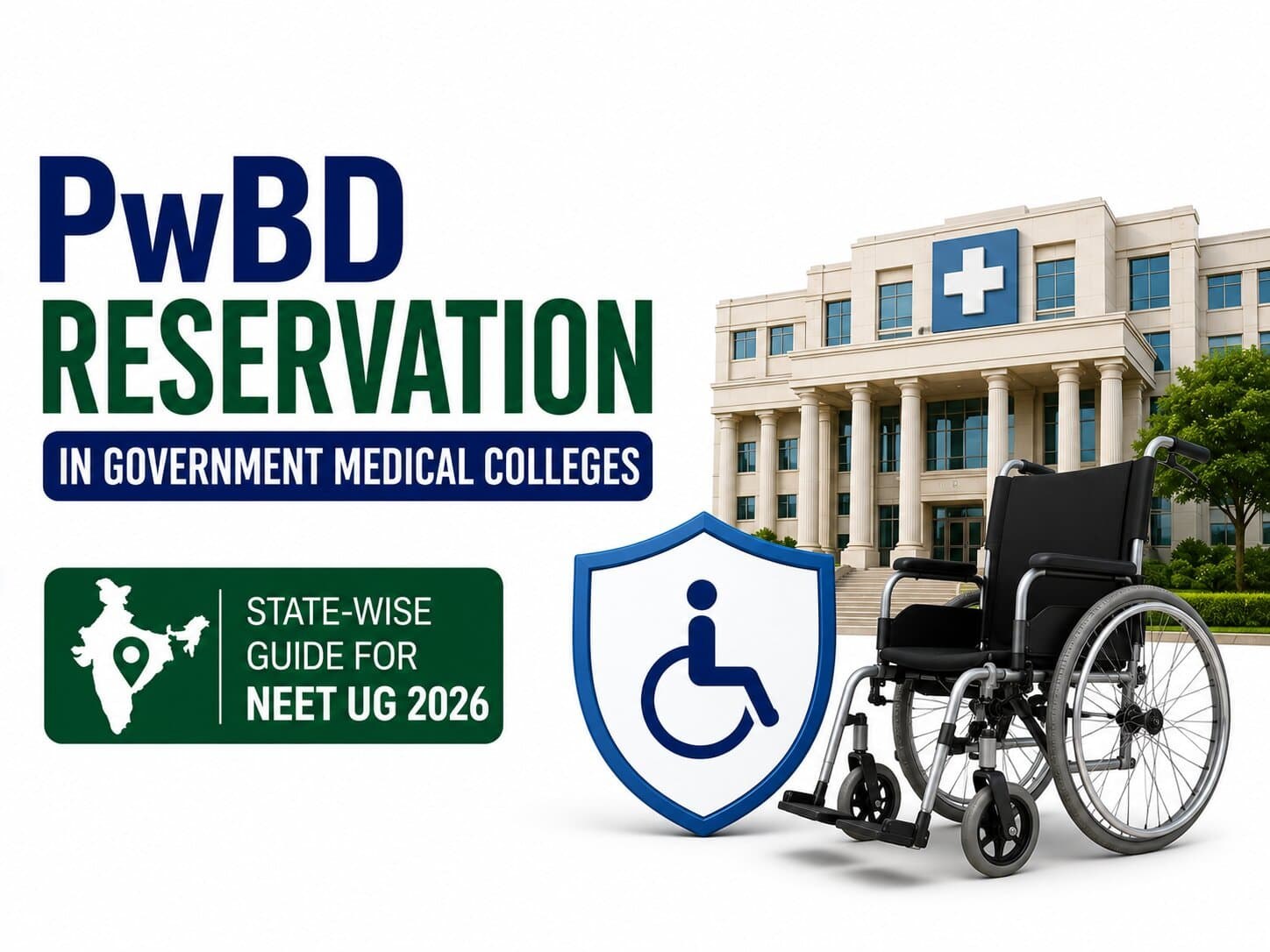
The earlier notice on PwBD requirements for West Bengal counselling covered the certificate and assessment process broadly, but a lot of candidates specifically want to know how PwBD reservation actually plays out in government medical colleges — where the bulk of the country's most affordable, most sought-after MBBS seats sit. This guide focuses squarely on that: how the 5% horizontal PwBD reservation works across government institutions nationally, how it differs between All India Quota and state quota seats, and what the state-wise seat landscape actually looks like.
The National Framework: What's Uniform Everywhere
Under the central reservation policy governing India's 15% All India Quota seats, along with 100% of seats at AIIMS, JIPMER, BHU, and other central institutions, PwBD candidates receive a 5% horizontal reservation applied across every other category — Unreserved, EWS, OBC-NCL, SC, and ST alike. This is uniform nationwide for AIQ seats specifically, and individual states cannot alter this percentage for that portion of the seat pool. The Medical Counselling Committee implements this framework strictly, and it applies identically whether a candidate is competing for a seat in Delhi, Chennai, or Kolkata through the AIQ route.
Horizontal Reservation: The Detail Most Candidates Misunderstand
This is worth explaining clearly, since it's one of the most commonly confused aspects of the entire reservation system. A "horizontal" reservation, unlike the "vertical" reservations that apply to SC, ST, OBC-NCL, and EWS categories, cuts across every vertical category rather than sitting alongside them. In practice, this means a PwBD candidate is first placed into their applicable vertical category — Unreserved, OBC-NCL, SC, ST, or EWS, based on their own background — and then benefits from the 5% horizontal PwBD reservation within that same category's seat allocation. A PwBD candidate doesn't compete in some entirely separate, isolated pool; they compete within their vertical category, with the horizontal reservation ensuring a proportionate share of seats within that category go to PwBD candidates specifically.
How State Quota PwBD Reservation Differs
The remaining 85% of government medical college seats fall under individual state quota systems, and this is where things genuinely vary. Each state's own health or medical education directorate sets and implements its own reservation policy for this portion of the seat pool, and while the 5% horizontal PwBD principle is broadly followed across most states, including West Bengal, the exact administrative process — which assessment boards conduct eligibility verification, how certificates are processed, and how seats are actually matched to verified candidates — differs from state to state. This is precisely why a PwBD candidate's experience navigating counselling in Maharashtra can look meaningfully different from the same candidate's experience in West Bengal, even though the underlying 5% principle is conceptually similar in both places.
The State-Wise Government Seat Landscape
Government MBBS seat distribution is heavily uneven across India, which directly affects how many PwBD-reserved seats exist in any given state in absolute terms, even where the 5% principle holds steady everywhere.
States with the largest government MBBS seat counts include Maharashtra, Gujarat, Karnataka, Tamil Nadu, Andhra Pradesh, and Telangana, each offering a correspondingly larger absolute number of PwBD-reserved government seats simply due to scale
India's total government MBBS seat count sits at roughly 63,000-plus seats nationally across government medical colleges, AIIMS, ESIC institutions, JIPMER, and AFMC combined
West Bengal's government seat count has grown meaningfully in recent cycles, which is worth understanding in the context of the state's overall medical college seat increase, since a larger overall seat base also means a larger absolute PwBD-reserved seat pool within the state, even with the percentage held constant
A candidate applying from a state with a smaller total government seat count faces a meaningfully different numbers picture than one applying from a large state, even when both are competing under the identical 5% horizontal principle.
Government Colleges Specifically vs. the Broader Private Landscape
It's worth being precise about scope here, since this is a genuinely different picture from the private college landscape. Government medical colleges — funded and run directly by central or state governments — are bound by the uniform reservation framework described above across both AIQ and state quota seats. Private and self-financing colleges, including their management quota allocations, generally operate under a different set of obligations, and PwBD reservation implementation there can look considerably less standardised. Candidates specifically prioritising a government seat because of this reservation clarity, rather than a private option, should factor that distinction directly into how they build their choice list, alongside the usual factors that go into choosing the right medical college overall.
The Eligibility Certificate Still Applies Here Too
Regardless of whether a PwBD candidate is targeting an AIQ seat through MCC or a state quota seat through their home state's counselling authority, the same underlying requirement applies: an Eligibility Certificate from a designated Medical Assessment Board, following the NMC's 2026 competency-based assessment guidelines, is a prerequisite for participating in counselling under this category. The detailed process, required documents, and this year's shift toward functional-ability assessment are covered in full in our companion guide, and it's worth treating that certificate process as equally urgent whether you're aiming for a government seat through AIQ, state quota, or both simultaneously. MCC's own counselling process for AIQ and central institution seats runs on its own separate timeline from state counselling, which is exactly why PwBD candidates juggling both tracks need to prepare certification early enough to meet whichever registration window comes first.
West Bengal's Government Colleges: What PwBD Candidates Should Know
For West Bengal specifically, PwBD reservation applies within WBMCC's state quota merit-list categories, alongside Unreserved, EWS, OBC-A, OBC-B, SC, and ST. Government medical colleges across the state — from the older, established institutions to newer district-level additions — all fall under this same reservation framework for their state-quota seats. Reviewing the full spread of medical colleges across West Bengal before finalising a choice list gives a clearer sense of where realistic government options actually sit, and understanding how your NEET score translates into a realistic rank matters just as much for PwBD candidates evaluating government seat competitiveness as it does for any other category.
What to Actually Do With This Information
Confirm which vertical category you fall under first, since your PwBD horizontal reservation applies within that category, not as a standalone pool
Track both AIQ and your home state's quota processes in parallel if you're eligible for both, since government seats exist in both pools
Get your Eligibility Certificate finalised well before either registration window opens, treating it as equally urgent to general document preparation
Build a shortlist that accounts for how uneven government seat distribution is across states, rather than assuming every state offers a comparable number of PwBD-reserved options
Stay engaged through later counselling rounds, since seats unfilled after Round 1 resurface through mop-up and stray vacancy processes, a pattern that applies to PwBD-reserved seats as much as any other category
Key Things to Remember
PwBD candidates receive a 5% horizontal reservation across government medical college seats nationally, applying uniformly to AIQ seats under MCC and, with state-specific administrative variation, to the 85% state quota seats governed by individual state authorities. This horizontal reservation operates within a candidate's vertical category, not as a separate isolated pool, and the absolute number of PwBD-reserved seats available varies significantly by state simply because total government seat counts differ so much across India. Government colleges offer more standardised reservation implementation than the private landscape, which is worth weighing directly when building a choice list. Whether targeting AIQ, state quota, or both, the Eligibility Certificate requirement applies uniformly, and getting it finalised early remains the single most important procedural step for any PwBD candidate this cycle.
This guide reflects the national PwBD reservation framework and general state quota principles as publicly available at the time of writing. State-specific implementation details vary — always verify current requirements directly through MCC, your relevant state counselling authority, and official notifications before finalising any application.
Article Stats
You Might Also Like
What Is the MS Course? A Complete Guide to Introduction, Eligibility, NEET PG Counselling and Preparation
What Is the MD Course? A Complete Guide to Introduction, Eligibility, NEET PG Counselling and Preparation
Tripura MBBS BDS Round 3 Re-Revised Schedule 2026: Choice Filling, Merit List, Allotment and Admission Dates