 All Articles
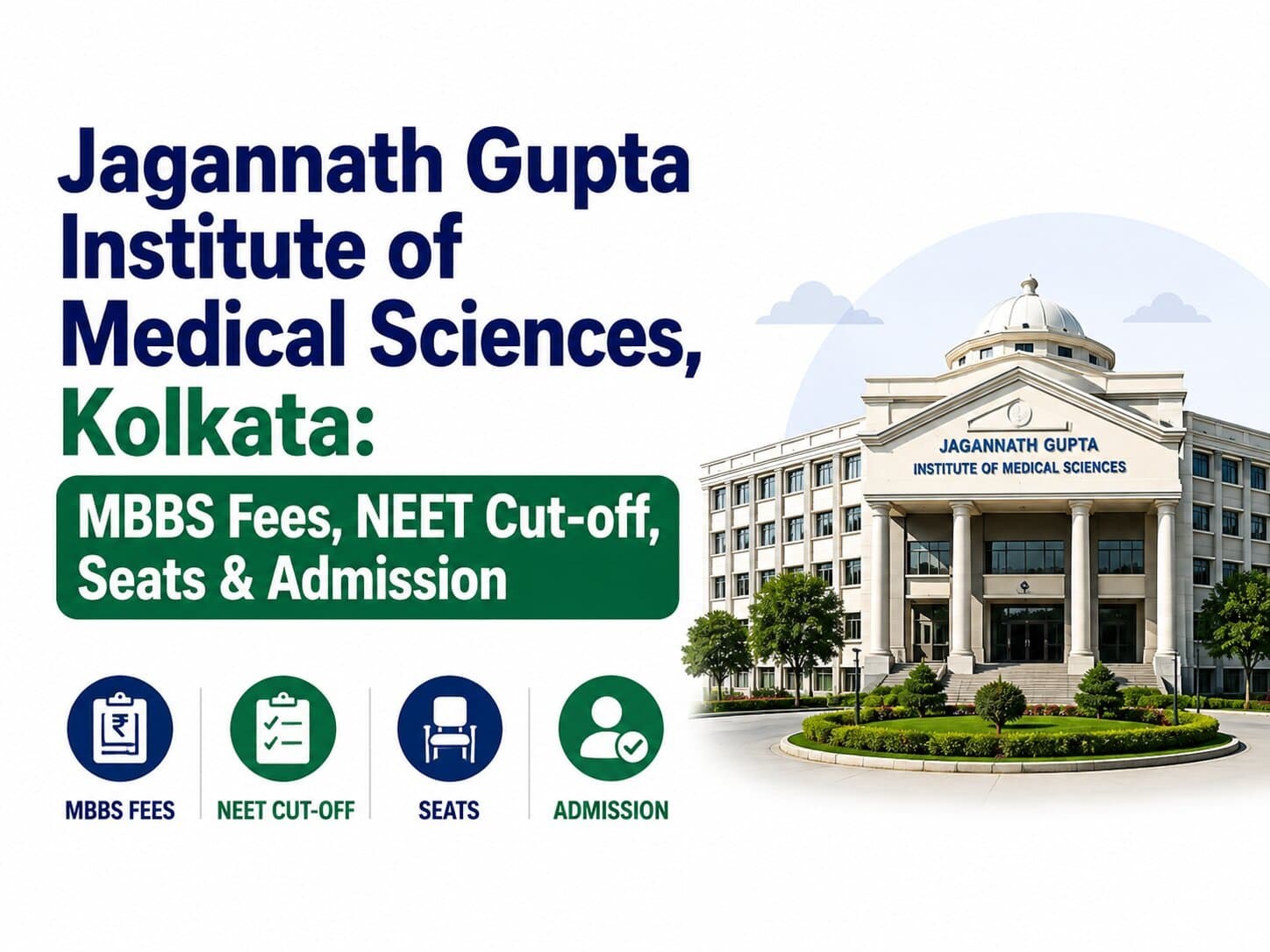
Jagannath Gupta Institute of Medical Sciences, Kolkata: MBBS Fees, NEET Cutoff, Seats & Admission
Among the private medical colleges that have emerged in West Bengal over the past decade, Jagannath Gupta Institute of Medical Sciences and Hospital — widely known as JIMSH or JIMS — has established itself as one of the more actively sought-after choices for NEET aspirants in the state. Located at Budge Budge in South 24 Parganas, approximately 25 kilometres from central Kolkata, the college has grown rapidly since its establishment in 2016 and now holds NMC recognition with an MBBS intake of up to 250 seats.
With the NEET UG 2026 result now declared and WBMCC counselling expected to begin in August, students shortlisting West Bengal private medical colleges need accurate, current data on JIMSH — its fees, cutoff trends, seat structure, hospital infrastructure, and admission process. This article covers all of it.
Quick Overview: Jagannath Gupta Institute of Medical Sciences
Before getting into the details, here is a snapshot of the key institutional facts:
Full name: Jagannath Gupta Institute of Medical Sciences and Hospital (JIMSH / JIMS)
Established: 2016
Location: Budge Budge (Buita), South 24 Parganas, Kolkata, West Bengal
Campus area: 24 acres
Trust: Urmila Devi Jagannath Gupta Charitable Trust
Affiliated university: West Bengal University of Health Sciences (WBUHS)
Recognition: National Medical Commission (NMC)
Accreditation: National Accreditation Board for Hospitals and Healthcare Providers (NABH)
MBBS seats: Up to 250 (NMC approved, 2025–26; verify for 2026–27 from WBMCC seat matrix)
Teaching hospital: 1,250 beds
ICU capacity: 70 beds
Operation theatres: 12 major + 6 minor
Admission route: WBMCC counselling (state quota) and management/NRI quota
The college sits under the JIS Group's broader educational ecosystem — the same group that operates JIS School of Medical Science and Research in Howrah — which accounts for its rapid infrastructure build-out since opening.
MBBS Seats and Quota Distribution at JIMSH Kolkata
NMC approved 250 MBBS seats at JIMSH for the academic session 2025–26. For the 2026–27 cycle, candidates must verify the final seat count from the official WBMCC seat matrix once it is released on wbmcc.nic.in ahead of counselling.
The 250 MBBS seats are divided across three quota categories:
State Quota (85%): Approximately 212 seats, filled through WBMCC counselling based on NEET UG merit list and West Bengal domicile
Management Quota (10%): Approximately 25 seats, filled through institutional-level admission process at significantly higher fees
NRI Quota (5%): Approximately 13 seats, reserved for NRI/OCI candidates through institutional process
The 85% state quota seats are further subdivided as per West Bengal's reservation policy: 22% for SC, 6% for ST, 17% for OBC-A and OBC-B combined, and 10% for EWS, with the remaining going to the General (UR) category. All category reservations under state quota apply only to West Bengal domicile candidates.
Of the state quota seats, 15% of the overall college intake flows through MCC All India Quota (AIQ) from the government quota portion — but for private colleges like JIMSH, all seats effectively route through WBMCC or institutional quota. AIQ does not directly cover private college seats in West Bengal; those are administered entirely through WBMCC state quota and institutional processes.
For students tracking West Bengal private medical college seat availability and MBBS costs, JIMSH is among the nine NMC-approved private medical colleges in the state that participate in WBMCC counselling.
JIMSH Kolkata MBBS Fee Structure
The fee structure at Jagannath Gupta Institute of Medical Sciences varies significantly between state quota and management quota seats — a distinction that matters enormously for financial planning before counselling choices are locked.
State Quota (WBMCC) Fees: Jagannath Gupta Medical College MBBS fees is ₹2,74,000 per semester for the general quota seats. With two semesters per academic year, the annual tuition under state quota works out to approximately ₹5,48,000. Over the full five and a half year MBBS programme plus internship, the total tuition cost under state quota is approximately ₹27–30 lakh, excluding hostel, mess, examination fees, and institutional charges which are billed separately and vary annually.
Management Quota Fees: The management quota fees is ₹10,94,000 per semester for the management quota seats. At ₹21,88,000 per year in tuition alone, the total tuition cost over five and a half years under management quota is approximately ₹1.1–1.2 crore. Management quota fees run above ₹22L/year.
NRI Quota Fees: NRI quota fees are ₹120L/year approximately ₹1.2 crore annually — making the total NRI quota cost for the full MBBS programme among the highest in the West Bengal private medical college landscape.
Additional costs to factor in: Hostel accommodation at JIMSH offers single, double, and triple room options with both AC and Non-AC variants. Mess charges, hostel rent, examination fees, university charges, and one-time security deposits all add to the annual cost beyond published tuition. Families evaluating JIMSH should calculate total annual costs — not just tuition — before finalising a counselling strategy.
For a structured comparison of government versus private MBBS costs in West Bengal, the WBMCC seat matrix and fee breakdown gives a complete picture of what each quota type costs across the state's medical colleges.
NEET Cutoff at JIMSH Kolkata: Past Data and Expectations
The NEET cutoff at Jagannath Gupta Institute of Medical Sciences is a function of WBMCC counselling dynamics — how many candidates in each category are competing for the available seats and where the last allotted candidate's rank falls in each round.
2024 WBMCC Cutoff (State Quota, General Category):
The WBJEE NEET UG counselling cutoff 2024 is AIR 46,637 in Round 3 for MBBS at Jagannath Gupta Institute of Medical Sciences and Hospital.
This means that in the third round of WBMCC counselling in 2024, the last seat in the General (UR) category at JIMSH was allotted to a candidate ranked approximately 46,637 in the All India merit list. In Round 1 and Round 2, cutoffs are typically tighter — the closing rank in Round 3 is generally more relaxed as seats that went unfilled in earlier rounds become available.
Category-wise cutoff pattern:
Reserved category cutoffs (OBC-A, OBC-B, SC, ST, EWS) at JIMSH follow West Bengal state reservation norms and typically close at category ranks substantially better than the General category AIR. A candidate with a General category AIR of 70,000–80,000 may hold an SC category rank that falls comfortably within the closing range for JIMSH under SC quota.
What to expect:
The NEET UG 2026 result has been declared. With an expanded MBBS seat count nationally — NMC added 9,911 seats for 2026–27 — and West Bengal gaining 825 additional MBBS seats this cycle, cutoffs at mid-tier private colleges like JIMSH may shift slightly compared to 2024. Whether this opens the cutoff (more seats available) or tightens it (more candidates also qualifying) depends on the specific category and round dynamics. The safest approach is to use 2024 Round 3 closing ranks as a directional baseline while building a choice list that accounts for possible variation.
Understanding what your 2026 NEET score means for your rank and which colleges fall within range is the analytical step that converts a result into a counselling strategy. For West Bengal students whose AIR falls in the 35,000–60,000 range, JIMSH typically falls within realistic reach in Round 2 or Round 3 of WBMCC counselling under the General category.
For a detailed view of JIMSH Kolkata's seat matrix, cutoff data, and college comparison against other West Bengal private medical colleges, the JIMSH college profile has current counselling data in one place.
Hospital and Clinical Infrastructure
The quality of clinical training at any medical college is ultimately determined by the affiliated teaching hospital — its bed strength, patient load, speciality depth, and OT exposure. JIMSH operates its own multi-speciality teaching hospital on campus, which is integral to its NMC recognition.
JIMSH's teaching hospital has 1,250 beds, 70 ICU beds, 12 major and 6 minor operation theatres. This is a substantially large hospital for a private medical college established in 2016 — many private colleges that have operated for decades have smaller hospital footprints. The 1,250-bed facility creates a patient load that supports meaningful clinical exposure across Medicine, Surgery, Obstetrics and Gynaecology, Paediatrics, Orthopaedics, and other core clinical postings.
The ICU capacity of 70 beds and the 12 major OT setup means students get exposure to critical care scenarios and surgical procedures at a volume that genuinely supports MBBS training. For students evaluating clinical exposure as a criterion — which is one of the most important factors in choosing between similarly-priced private colleges — JIMSH's hospital infrastructure represents a comparative strength relative to newer or smaller private institutions in the state.
The hospital is NABH accredited, which is an independent quality certification from the National Accreditation Board for Hospitals and Healthcare Providers. NABH accreditation covers quality standards in patient safety, clinical care, and administrative processes — and its presence at JIMSH adds an external quality verification layer beyond NMC's educational recognition.
Academic Infrastructure and Campus
JIMSH is spread across a 24-acre campus in Budge Budge, Kolkata, with infrastructure designed around integrated medical education. The campus includes:
Smart classrooms with audio-visual learning facilities
A central library with digital resources, medical journals, and reference books
Modern dissection halls and anatomy laboratories
Biochemistry, physiology, pathology, and microbiology laboratories equipped for practical training
Simulation-based medical training facilities
Demonstration rooms for clinical skill practice
Sports and recreational facilities
Cafeteria and student support services
The library and laboratory infrastructure matters particularly for NEET PG preparation — students who have access to comprehensive reference resources during their MBBS consistently perform better in postgraduate entrance examinations. The simulation-based training infrastructure is increasingly important as the NMC pushes medical education toward competency-based formats.
Postgraduate Programmes at JIMSH
Beyond MBBS, Jagannath Gupta Institute of Medical Sciences offers postgraduate MD and MS programmes across multiple specialities. The availability of PG programmes at an institution where a student does their MBBS is a meaningful consideration — students who perform well during MBBS at the same institution may have familiarity advantages in PG admission interviews, and the presence of PG residents creates a richer clinical learning environment for MBBS students through direct interaction with senior medical trainees.
JIMSH offers MD and MS programmes at the PG level, along with GNM, BSc Nursing, BPharma, Diploma and Paramedical programmes at the UG level.
The PG cutoffs at JIMSH under NEET PG are separate from the MBBS cutoffs and follow WBMCC's postgraduate counselling schedule. Candidates interested in NEET PG admission at JIMSH after completing MBBS elsewhere should track the WB NEET PG counselling process separately.
Other Courses Available at JIMSH Kolkata
Students who do not secure an MBBS seat at JIMSH — either because their NEET UG rank places them outside the MBBS cut-off range or because they are evaluating alternate pathways — should know that the institution offers a range of allied healthcare programmes:
GNM (General Nursing and Midwifery): Three-year diploma nursing programme
BSc Nursing: Four-year undergraduate nursing degree
BPharma: Four-year undergraduate pharmacy degree
Diploma programmes: Various paramedical diplomas
Paramedical courses: Allied health sciences training
For students exploring paramedical diploma courses in West Bengal more broadly, the SMFWBEE 2026 paramedical admission process covers the state-level entrance examination that governs admission to diploma courses at SMFWB-affiliated institutions across the state — a parallel pathway to institutional programmes like those at JIMSH.
Eligibility Criteria for MBBS Admission at JIMSH
The eligibility conditions for MBBS admission at Jagannath Gupta Institute of Medical Sciences follow NMC's national guidelines for MBBS admission:
Must have passed Class 10+2 or equivalent examination from a recognised board
Must have studied Physics, Chemistry, and Biology as core subjects with English
Minimum 50% aggregate marks in PCB for General/OBC/EWS categories; 40% for SC/ST/PwD categories
Must have qualified NEET UG with a valid score in the current examination cycle
Must have attained the age of 17 years on or before December 31 of the year of admission
Must be a citizen of India (for state quota and management quota seats)
West Bengal domicile is required for state quota seat eligibility under WBMCC counselling. Candidates without West Bengal domicile are not eligible for state quota seats at JIMSH and must pursue management quota or NRI quota routes, which carry substantially higher fees and different admission processes.
Admission Process for JIMSH MBBS
MBBS admission at Jagannath Gupta Institute of Medical Sciences happens through two distinct routes:
Route 1 — State Quota via WBMCC (85% of seats):
This is the standard NEET UG counselling route. Candidates who have qualified NEET UG 2026 with West Bengal domicile register on the WBMCC portal, pay the counselling fee, fill their choice list ranking JIMSH at an appropriate position relative to other preferred colleges, and await allotment through the merit-based algorithm. The WBMCC counselling process for 2026 is expected to begin in August, following MCC AIQ counselling. Understanding the complete WBMCC counselling process for West Bengal students is essential before registration opens.
After receiving a WBMCC allotment for JIMSH, candidates must report to the college within the specified window carrying all original documents — NEET scorecard, Class 10 and 12 certificates and marksheets, domicile certificate, category certificate if applicable, WBMCC allotment letter, medical fitness certificate in prescribed format, and passport-size photographs. Admission is confirmed after document verification and first-year fee payment at the college.
Route 2 — Management Quota (10% of seats):
MBBS admissions in JIMSH Medical College under management quota are done only through WBMCC counselling. This is distinct from some other states where management quota is filled through direct institutional admission. In West Bengal, even management quota seats at private colleges are routed through WBMCC — candidates who wish to apply for management quota at JIMSH must register on the WBMCC portal specifically for management quota and go through the counselling process at the higher fee structure.
Route 3 — NRI Quota (5% of seats):
NRI quota admission requires the candidate to be sponsored by an NRI relative. The process involves submitting NRI sponsorship documentation, relationship affidavits, and the sponsor's passport and visa copies to the institution. NRI quota seats at JIMSH carry annual fees of approximately ₹1.2 crore and are processed through the college's institutional admission office.
Documents Required at JIMSH Reporting
At the time of physical reporting after WBMCC allotment, candidates must carry the following original documents along with two sets of self-attested photocopies:
NEET UG 2026 scorecard and rank letter
WBMCC allotment letter (printed from portal)
NEET UG 2026 admit card
Class 10 marksheet and passing certificate (date of birth verification)
Class 12 marksheet and passing certificate
Domicile / residence certificate of West Bengal
Category certificate (OBC-A, OBC-B, SC, ST, EWS) in current-year format if applicable
Valid photo ID (Aadhaar card preferred)
Medical fitness certificate in NMC / WBMCC prescribed format
Passport-size photographs (minimum 8 copies)
Income certificate if applying under EWS or specific fee-waiver categories
Missing any original document at the reporting counter can result in admission being deferred or, in the worst case, seat cancellation within the tight reporting window. Preparing all documents well before counselling begins — not after receiving an allotment — is the approach that avoids last-minute document errors.
Location and Connectivity
Jagannath Gupta Institute of Medical Sciences and Hospital is located at Budge Budge, Kolkata, West Bengal, Budge Budge is in South 24 Parganas, approximately 25 kilometres south of central Kolkata along the Diamond Harbour Road corridor.
For students from within Kolkata and its suburbs, the commute is manageable, and the college's hostel facilities make on-campus residence a practical option. For students from North Bengal, Jharkhand, Bihar, or other states, Budge Budge is accessible via Kolkata's railway network — the Budge Budge station on the Sealdah South section is the nearest railhead — though the commute from central Kolkata to the campus takes approximately 45 to 60 minutes depending on traffic.
The location is outside central Kolkata's congestion, which means the campus environment is quieter than centrally located institutions — an advantage for focused study during the MBBS years. The trade-off is that students who need regular access to central Kolkata for personal or family reasons should factor in the commute time when evaluating residential arrangements.
How JIMSH Compares to Other West Bengal Private Medical Colleges
West Bengal has nine NMC-approved private medical colleges. Within this group, JIMSH sits in a specific competitive position defined by its relatively large intake (250 seats), its NABH accreditation, its 1,250-bed teaching hospital, and its NEET cutoff range that typically falls in the AIR 35,000–55,000 bracket for General category candidates in later WBMCC rounds.
Compared to KPC Medical College Jadavpur — which is closer to central Kolkata and has a longer operational history — JIMSH offers a larger intake and a bigger hospital but slightly less locational advantage for Kolkata-based students. Compared to IQ City Medical College in Durgapur, JIMSH has the advantage of proximity to Kolkata but IQ City has a more established brand in clinical training. JMN Medical College in Nadia draws from a different geographic catchment.
For West Bengal students building their WBMCC choice list, JIMSH typically sits in the middle tier of private college preferences — above smaller or newer private institutions and below the most established ones — which makes its placement in the preference order a strategic decision rather than an obvious one. The detailed JIMSH college profile alongside comparison data for other West Bengal private colleges helps candidates make this placement decision with verified data rather than reputation alone.
Understanding how mop-up and stray vacancy rounds work in WBMCC counselling is also relevant for JIMSH specifically — because its cutoff in Round 3 is noticeably more relaxed than in Round 1, meaning candidates who do not receive it in early rounds sometimes access it in the mop-up stage.
Scholarships for MBBS Students at JIMSH
Students who secure admission at JIMSH under state quota — with fees around ₹5,48,000 per year — should simultaneously explore financial support options that partially offset the annual cost.
The Swami Vivekananda Merit Cum Means Scholarship (SVMCM) provides annual financial support of up to ₹60,000 for eligible West Bengal students pursuing MBBS at recognised private institutions. The eligibility criteria include family income thresholds, West Bengal domicile, and minimum academic performance. Given that JIMSH is a WBUHS-affiliated NMC-recognised institution, its MBBS students are eligible for this scholarship subject to individual eligibility criteria.
Beyond SVMCM, several other scholarships for medical students after Class 12 cover MBBS students at both government and private institutions — including minority scholarships through Aikyashree, OASIS Post-Matric Scholarship for SC/ST students, and the WB Government Merit-cum-Means Scholarship. Researching and applying for these scholarships alongside the admission process — not after the year begins — ensures no application window is missed.
Is JIMSH the Right Choice for You?
The answer depends on where your NEET UG 2026 rank places you relative to the West Bengal private college landscape, what your financial capacity is, and what your priorities are for clinical training and career trajectory.
If your AIR falls in the range where government MBBS in West Bengal is not accessible but private MBBS is viable financially, JIMSH presents a defensible choice — it has NMC recognition, a large teaching hospital, NABH accreditation, and an intake of 250 seats that creates meaningful peer diversity. For families who can manage the ₹5–6 lakh annual cost of state quota MBBS at JIMSH, it represents a structured, recognised pathway to an MBBS degree with genuine clinical exposure.
If your AIR falls within range of government colleges at WBMCC — check the top government medical colleges in West Bengal and their historical closing ranks — those should take priority given the dramatically lower fees and typically stronger clinical training environments. JIMSH should appear lower in your preference list than any government college that is realistically accessible.
For students who want a detailed view of JIMSH's seat matrix, cutoff history across all rounds and categories, fee breakdown, and comparison against other West Bengal private colleges, the JIMHS college profile page has that data in structured form — useful for building the choice list before the WBMCC window opens.
The NEET UG 2026 result is out. WBMCC counselling begins in August. The time to research your college options is now — before the choice-filling deadline arrives and every decision has a clock attached to it.
All fee figures, seat counts, cutoff data, and institutional details in this article are based on verified data from NMC approvals, WBMCC seat matrices, and published 2024 counselling records. Figures for the 2026–27 academic session — including seat counts, fees, and cutoffs — will be confirmed by WBMCC in the official information brochure. Always verify current data at wbmcc.nic.in and the institution's official website before making any admission decision.
Article Stats