 All Articles
Exam Day Guidelines: What to Carry, Dress Code & OMR/CBT Rules for WBJEE and JEE Main
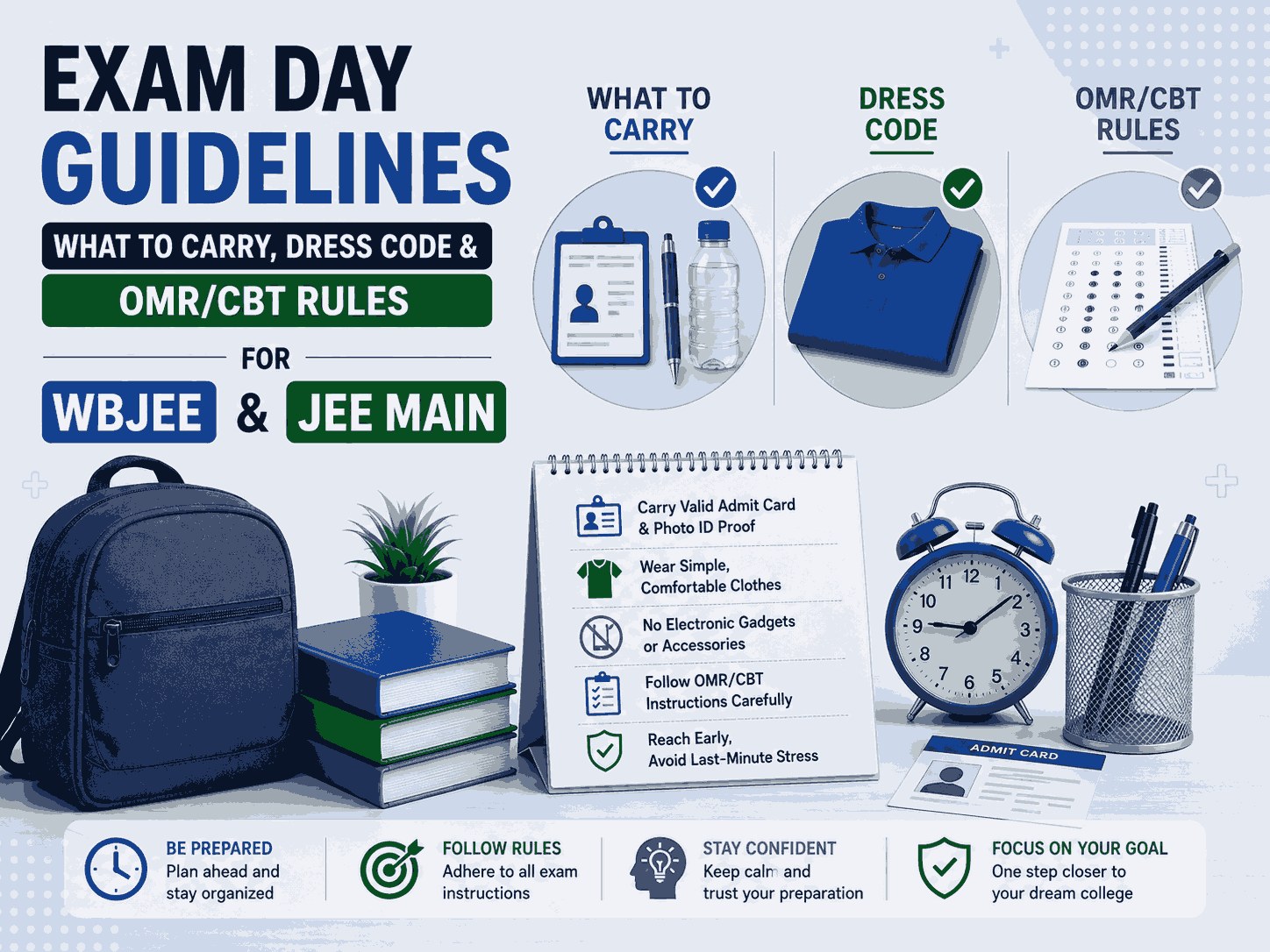
Exam-day mistakes are some of the most avoidable - and some of the most costly. A missing ID proof, a metallic zipper, or a stray mark on the OMR sheet can cost you far more than a tough question ever would. Since WBJEE and JEE Main run on completely different formats - one offline OMR-based, the other a fully online CBT - the rules for each differ in important ways. Here's a clear breakdown of both.
WBJEE: What to Carry to the Exam Centre
For WBJEE, only a small, strictly defined set of items is allowed inside the exam hall. Candidates must carry a printed copy of their admit card, one original valid photo ID proof, and a copy of the colour photograph uploaded during the application process. Beyond the admit card and ID, the only writing instrument permitted is a black or blue ballpoint pen — no pencils, gel pens, or ink pens are allowed, since WBJEE's OMR sheets are specifically calibrated for ballpoint ink.
No calculators, log tables, wristwatches, mobile phones, Bluetooth devices, or any communication gadgets are permitted, and no written or printed material of any kind — including rough notes — can be carried inside.
WBJEE: Dress Code
WBJEEB doesn't publish an ultra-strict formal dress code, but the practical guidance is consistent every year: wear light, simple, and comfortable clothing. Avoid heavy embroidery, metallic buttons, zippers, or any other metallic elements, since these are likely to slow you down at the security check or trigger additional frisking. Skip jewellery, rings, chains, and other accessories entirely, and choose footwear that's easy to remove or check quickly if needed.
WBJEE: OMR Sheet Filling Rules
The OMR sheet is where small errors do the most damage, since there's no provision for correction once an answer is marked. Start by checking that your OMR sheet number matches your question booklet number — if they don't match, ask your invigilator immediately to replace the entire set from the same series.
Fill in your name in BLOCK LETTERS, along with your centre name, roll number, and signature, only in the designated spaces — any stray mark elsewhere on the sheet can lead to rejection. Use only a black or blue ballpoint pen throughout; darken each response circle completely and cleanly, since gel pens or partial marks can cause read errors during scanning. Mark only one response per question, and don't attempt to erase or overwrite a marked answer — if you make an error, there's no fixing it, so double-check before you commit to filling any bubble.
JEE Main: What to Carry to the Exam Centre
JEE Main's CBT format actually restricts personal items more heavily than WBJEE, since almost everything you'd need is provided at the centre itself. Carry your printed admit card and a valid original photo ID — photocopies typically aren't accepted. Beyond that, don't bring your own stationery: pens, pencils, geometry boxes, rulers, or any other personal writing tools aren't needed, since rough sheets and any required stationery are provided at the centre for CBT-mode exams.
Textbooks, printed notes, handwritten formula sheets, or any paper with content are strictly prohibited, as are calculators, log tables, and all electronic devices — mobile phones, smartwatches, earphones, and Bluetooth gadgets included. Diabetic candidates are typically permitted to carry allowed eatables like sugar tablets or fruit, subject to the specific relaxations listed on the admit card.
JEE Main: Dress Code
NTA doesn't mandate a strict formal uniform, but the practical guidelines are meant to make security checks and metal-detector frisking go smoothly. Wear simple, comfortable clothing — plain T-shirts, shirts, trousers, jeans, or salwar suits work well. Avoid caps, scarves, stoles, or any head covering, and skip all jewellery, metallic buttons, zippers, or badges. Footwear should lean toward open sandals or slippers rather than shoes, especially thick-soled ones, since these can slow down security checks. No wristwatch of any kind — analog, digital, or smart — is allowed inside the hall; centres provide a wall clock instead.
JEE Main: CBT (Computer-Based Test) Rules
Since JEE Main is conducted entirely on computer, its rules differ meaningfully from a pen-and-paper exam like WBJEE. Candidates answer using a mouse and keyboard at an allotted workstation, and any rough work is done on sheets provided at the centre — not on paper you bring yourself.
Reach the centre well ahead of the reporting time specified for your shift, since entry is denied after gate-closing time under any circumstances, regardless of the reason. Once inside the hall, candidates are not permitted to leave the premises before the exam concludes. Follow the on-screen instructions and invigilator directions carefully, since navigating between questions, marking for review, and submitting responses all happen through the software interface rather than physical paper — a different rhythm from OMR-based exams that's worth practicing with mock tests beforehand.
What to Do Now
Prepare a fixed checklist a day in advance for whichever exam you're appearing for — admit card copies, valid photo ID, and (for WBJEE specifically) a couple of black or blue ballpoint pens — rather than assembling things on exam morning.
Choose your exam-day outfit the night before based on the dress code guidance above, prioritizing simplicity over style to avoid any delay during frisking.
If you're appearing for WBJEE, practice filling a sample OMR sheet at least once beforehand, so the block-letter entries, centre details, and bubble-marking process feel familiar rather than something you're doing for the first time under exam pressure.
If you're appearing for JEE Main, take a full-length mock test in the actual CBT interface beforehand, so you're comfortable navigating between questions, marking for review, and managing on-screen time — skills that don't transfer directly from paper-based practice.
Key Things to Remember
WBJEE requires a black or blue ballpoint pen for the OMR sheet - pencils and gel pens are not accepted and can lead to rejection.
JEE Main provides all necessary stationery and rough sheets at the centre - candidates don't need to (and generally shouldn't) bring their own.
Both exams strictly prohibit electronic devices, watches, jewellery, and printed material inside the exam hall.
WBJEE OMR errors cannot be corrected once marked - accuracy on the first attempt is essential, since there's no do-over.
JEE Main's CBT format means practicing with the actual on-screen interface beforehand matters just as much as subject preparation.
This article is based on officially published and commonly reported exam-day guidelines for WBJEE and JEE Main. Candidates should always verify the exact, current-year instructions on their individual admit cards and the official WBJEEB and NTA websites before exam day, since specific rules can be updated each session.
Article Stats
You Might Also Like
What Is the MS Course? A Complete Guide to Introduction, Eligibility, NEET PG Counselling and Preparation

What Is the MD Course? A Complete Guide to Introduction, Eligibility, NEET PG Counselling and Preparation

Tripura MBBS BDS Round 3 Re-Revised Schedule 2026: Choice Filling, Merit List, Allotment and Admission Dates