 All Articles
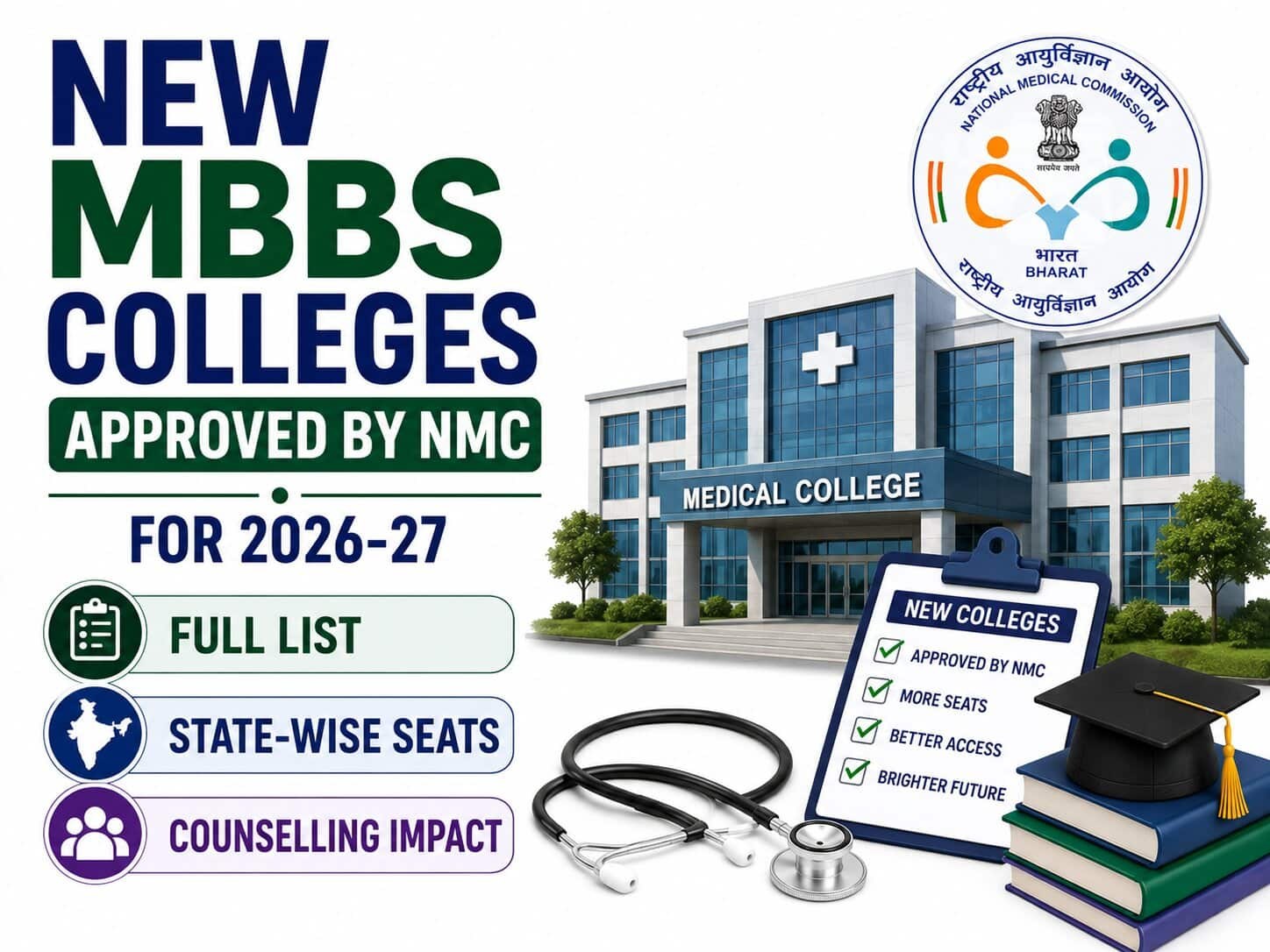
New MBBS Colleges Approved by NMC for 2026-27: Full List, State-Wise Seats and Counselling Impact
The National Medical Commission has approved 25 new medical colleges for the 2026-27 academic session — adding 2,400 fresh MBBS seats to India's undergraduate medical education system. Combined with seat increases at existing institutions, the total new seats added for 2026-27 stand at 9,911, taking the national MBBS seat count to 1,36,939 across 823 medical colleges (excluding Institutes of National Importance like AIIMS and JIPMER).
The seat matrix was published by the Medical Assessment and Rating Board (MARB), the regulatory body within NMC responsible for assessing and approving medical colleges, through a public notice dated July 14, 2026, based on approvals granted as of July 13, 2026. This is the figure that every state counselling authority — including WBMCC — and MCC uses as the basis for their 2026-27 seat allotment matrices.
For every NEET UG 2026 candidate currently in the counselling process, this is directly actionable information. New colleges mean new seats in the pool. New seats mean the competitive landscape at certain rank ranges shifts. And new establishments — particularly those still awaiting their final Letter of Permission — require specific due diligence before being included in any choice list.
The National Picture: What 9,911 New Seats Actually Mean
India's MBBS seat expansion trajectory has been consistent and significant. In 2025-26, 7,375 seats were added, taking the total to approximately 1,24,825. This year, 9,911 seats have been added — a 33% larger expansion than the previous cycle. The government's underlying commitment is PM Modi's Independence Day 2024 pledge to create 75,000 new medical seats over five years. The 2026-27 addition keeps that pace on track.
Of the 1,36,939 total seats approved for 2026-27, the split between institution types is significant for counselling strategy:
Government medical colleges: 63,296 seats across 441 institutions
Private medical colleges: 73,643 seats across 382 institutions
For the first time in several years, private college seats now meaningfully outnumber government seats in the national count. This reflects a structural reality: while government seat expansion is continuing, private sector growth is moving faster. For candidates whose NEET 2026 rank places them in the zone where government MBBS is uncertain, this expanded private seat pool offers more options than ever before — at the cost of higher fees.
The 25 new colleges approved for 2026-27 break down as 7 government colleges adding 400 seats and 18 private colleges adding 2,000 seats. This 83% private skew in new establishments reflects both the higher application volume from private sector promoters and the government's selective approach to establishing new public medical institutions in regions of genuine scarcity.
The 25 New MBBS Colleges: Complete List from the NMC Seat Matrix
The following colleges are new establishments approved by MARB for the 2026-27 academic session, as confirmed in the official NMC seat matrix dated July 13, 2026. All figures are verified from the uploaded official document:
Chhattisgarh — 5 New Government Medical Colleges (250 seats)
Government Medical College Dantewada — 50 seats
Government Medical College Janjgir-Champa — 50 seats
Government Medical College Jashpur-Kunkuri — 50 seats
Govt. Medical College Kabeerdham — 50 seats
Govt. Medical College Manendragarh — 50 seats
Karnataka — 2 New Private Colleges (250 seats)
Alva's Institute of Medical Sciences and Research Centre — 150 seats
Chettinad Institute of Medical Education and Research — 100 seats
Tamil Nadu — 1 New Private College (150 seats)
APS Medical College Hospital and Research Institute — 150 seats
Maharashtra — 2 New Private Colleges (250 seats)
B.S.P. Medical College and Hospital — 150 seats
Mauli Medical College Hospital & Research Center — 100 seats
Rajasthan — 3 New Private Colleges (350 seats)
Bharat Vikas Institute of Medical Sciences — 150 seats
Dr. B.S. Tomar Institute of Medical Sciences and Research — 150 seats
Prince Medical College & Hospital — 50 seats
Bihar — 2 New Private Colleges (200 seats)
Buddha Hospital and Research Institute — 100 seats
Shrinivas G Educational & Research Institute of Medical Sciences — 100 seats
Uttar Pradesh — 2 New Private Colleges (150 seats)
Fulan Singh Medical College, FS University — 100 seats
Sardar Patel Institute of Medical Education and Health Sciences — 50 seats
Andhra Pradesh — 2 New Private Colleges (100 seats)
Government Medical College Piduguralla — 50 seats
RVS Institute of Medical Sciences — 50 seats
West Bengal — 1 New Private College (150 seats)
SKS Medical College — 150 seats
Telangana — 1 New Private College (150 seats)
Raja Rajeshwari Institute of Medical Sciences-Girls — 150 seats
Jharkhand — 1 New Private College (100 seats)
Sido Kanhu Medical College and Hospital — 100 seats
Haryana — 1 New Private College (100 seats)
Sanskaram School of Medical Sciences — 100 seats
Chhattisgarh — 1 New Private College (100 seats)
Maa Padmavati Institute of Medical Sciences — 100 seats
Sikkim — 1 New Government College (100 seats)
Sikkim Government Medical College — 100 seats
State-Wise Impact: Who Gained the Most
Looking at the broader seat expansion picture — combining new establishments with seat increases at existing colleges — several states stand out for the 2026-27 cycle:
Karnataka leads all states with 1,300 additional MBBS seats, taking its total to 15,395. With two new private colleges adding 250 seats and significant increases at existing institutions, Karnataka continues to hold the highest total MBBS seat count in India. For candidates from any state evaluating management quota options in open states, Karnataka remains the largest accessible private college market — a context covered in the top medical colleges in West Bengal alongside inter-state comparison guidance.
West Bengal has gained 825 seats, taking its total to 7,200. SKS Medical College's 150 new seats are part of this gain. The expansion matters specifically for candidates in the WBMCC 2026 counselling process — more seats in the West Bengal private college pool means slightly more choice filling depth for candidates whose rank places them in the private MBBS range.
Telangana adds 810 seats taking its total to 10,250, with Raja Rajeshwari Institute of Medical Sciences-Girls contributing 150 of those from the new establishment list. Uttar Pradesh adds 800 seats (total: 14,000). Bihar gains 740 seats (total: 4,160). Maharashtra gains 400 seats (total: 13,099).
Chhattisgarh deserves specific attention. Five new government medical colleges — Dantewada, Janjgir-Champa, Jashpur-Kunkuri, Kabeerdham, and Manendragarh — add 250 government seats in a single cycle. These are all in tribal and underserved regions of the state, consistent with the government's mandate to establish medical colleges in districts without existing facilities. Candidates registered for Chhattisgarh NEET UG 2026 counselling should verify whether these new colleges are included in the 2026-27 counselling seat matrix, as last-minute additions sometimes have phased integration.
Sikkim Government Medical College — with 100 seats — represents the only new government college outside Chhattisgarh and Andhra Pradesh in this cohort. Sikkim had no government medical college prior to this approval, making this a landmark development for the northeastern region's medical education access.
The Critical Due Diligence Point: Letter of Permission and E-Bank Guarantee
This is the most important piece of information for any candidate considering a new college in their choice list, and it is the one that most articles on this topic either do not mention or bury in a footnote.
MARB's public notice dated July 14, 2026, explicitly states that private medical colleges receiving new establishment approval or seat increases must submit an Electronic Bank Guarantee (E-Bank Guarantee) to MARB within 7 days of the approval to receive their final Letter of Permission (LoP). The LoP is the formal authorization that allows the college to admit students.
Colleges that fail to submit the E-Bank Guarantee within the 7-day window risk losing their approved seats — meaning those seats would not appear in the final counselling seat matrix used by MCC or state authorities for allotment. For candidates who include such a college in their choice list based on the preliminary MARB approval, the risk is a seat that appears available at choice filling but is absent from the final allotment matrix.
Before including any new establishment college in your choice list, verify two things:
Whether the college has received its final Letter of Permission (not just the provisional MARB approval)
Whether the college appears in the final seat matrix published on mcc.nic.in or the relevant state counselling authority's portal
The NMC's own public notice is clear: "The seat matrix published is based on approvals granted as of July 13, 2026, and may be revised if required based on decisions of the Appeal Committee or any other competent authority." A revised matrix will be published on nmc.org.in. Always cross-reference any new college against the most current version of the matrix on the official portal.
Understanding how the full counselling process works — and where the seat matrix fits within the sequence from registration to allotment — is foundational before building any choice list that includes new establishments.
SKS Medical College, West Bengal: What Candidates Need to Know
For West Bengal candidates currently going through WBMCC Round 1 counselling, SKS Medical College is the one new establishment directly relevant to the state's seat pool.
SKS Medical College has been approved for 150 MBBS seats under the private (self-financing) category. Whether these seats appear in WBMCC's Round 1 seat matrix — published on August 19, 2026 — depends on whether SKS Medical College has completed its E-Bank Guarantee submission and received its final LoP.
Candidates shortlisting West Bengal private colleges should:
Check the WBMCC Round 1 seat matrix on August 19 to confirm whether SKS Medical College is included
Verify NMC recognition status at nmc.org.in before including it in your preference order
Not assume that MARB approval automatically means the college is in the counselling pool
This due diligence applies to every new establishment in the list — not just SKS Medical College. The verification step takes five minutes and prevents a potentially significant error in choice filling.
What This Means for NEET UG 2026 Counselling Strategy
The addition of 9,911 seats has two distinct effects on the counselling landscape — one that helps candidates and one that requires careful navigation.
The helpful effect: more seats means more options at every rank range. Candidates in the AIR 40,000–1,00,000 bracket — where government MBBS is generally outside reach and private MBBS is the realistic pathway — now have a wider pool of private college options than in any previous year. States like Karnataka (1,300 new seats) and Telangana (810 new seats) have expanded their open-state private college pools meaningfully. The marks vs rank vs college analysis for NEET 2026 gives the data-driven starting point for understanding which rank ranges benefit most from this expansion.
The navigation challenge: new colleges — particularly the 18 private establishments — are unproven institutions at the time of counselling. They have no alumni outcomes, no established hospital track records, no published NEET PG pass rate data. For a candidate whose medical career over the next five and a half years depends on clinical exposure quality, choosing a brand-new institution with no operational history requires more due diligence than choosing an established college with known outcomes.
The questions worth asking before including a new private college in your preference list: Has the affiliated teaching hospital been operational? What is the bed strength? Has the infrastructure been verified by NMC inspection teams as part of the LoP process? Are clinical departments staffed with qualified faculty?
For candidates navigating these decisions across multiple states — MCC AIQ, WBMCC state quota, and management quota at open-state private colleges — the complete picture of what counselling support covers at each stage helps candidates understand what to prioritise and what to verify before any preference list is locked.
The Policy Shift That Made This Possible
A significant regulatory change underlies the scale of 2026-27's seat expansion. Previously, medical colleges had to wait five years after initial establishment before they could apply for a seat increase. The NMC revised this policy, reducing the waiting period substantially. This is why established institutions could apply for seat increases earlier than before — accelerating the expansion of existing, verified, operationally established colleges alongside the new establishment approvals.
For candidates evaluating colleges with seat increases rather than new establishments, this distinction matters: a seat increase at an established, operational college with a track record is categorically different from a seat increase at a college that is just beginning to operate. Both appear in the same seat matrix with the same "seats increased" designation — but the due diligence required is different.
Understanding how mop-up and stray vacancy rounds interact with new establishments is also relevant. New colleges sometimes have seats remaining unfilled after Round 1 and Round 2 — either because they are new and less known, or because LoP confirmation came late in the process. This means candidates who did not receive an allotment in early rounds sometimes access new college seats at more relaxed closing ranks in later rounds.
Counselling Priorities Right Now
For candidates currently in active counselling processes — WBMCC Round 1 (registration August 13–16), MCC AIQ (allotment result August 17), and parallel state counselling across Chhattisgarh, Odisha, Karnataka, and others — the new college list is reference information rather than immediate action.
The immediate action is counselling registration and choice filling. The NEET UG 2026 result is the basis for every decision. Candidates whose rank data is confirmed can now map options across new and established colleges using updated seat matrices. For West Bengal candidates specifically, tracking both the WBMCC seat matrix when it publishes on August 19 and the NEET UG top states qualified data gives the full competitive context before filling any preference.
For candidates managing multiple counselling windows simultaneously — including WBJEE 2026 counselling for engineering alongside NEET, or SMFWBEE 2026 paramedical admissions as a parallel option — the August–September calendar is the densest it has been in the 2026 admissions cycle.
Financial support research should run in parallel with college shortlisting. The Swami Vivekananda Merit Cum Means Scholarship for West Bengal students and the full range of scholarships for medical students after Class 12 have application windows that open around admission confirmation — knowing eligibility now means no window is missed.
The seat expansion is the largest in recent memory. The opportunity it creates is real. The due diligence it requires — particularly for new establishments — is equally real.
Understanding your rank's realistic range across both established and new college options, with verified LoP and NMC recognition status, is the foundation of a choice list that translates the 2026-27 seat expansion into an actual admission.
All new college and seat data in this article is sourced from the official NMC MBBS Seat Matrix for AY 2026-27, published by the Medical Assessment and Rating Board (MARB) as on July 13, 2026, and the public notice dated July 14, 2026. The seat matrix excludes Institutes of National Importance (INIs) including AIIMS and JIPMER. State-wise total seat figures are based on verified media reports from India TV News, Free Press Journal, and Medical Dialogues. The seat matrix may be revised based on Appeal Committee decisions — always verify final seat availability from the current matrix at nmc.org.in and mcc.nic.in before finalising any counselling choice.
Article Stats