 All Articles
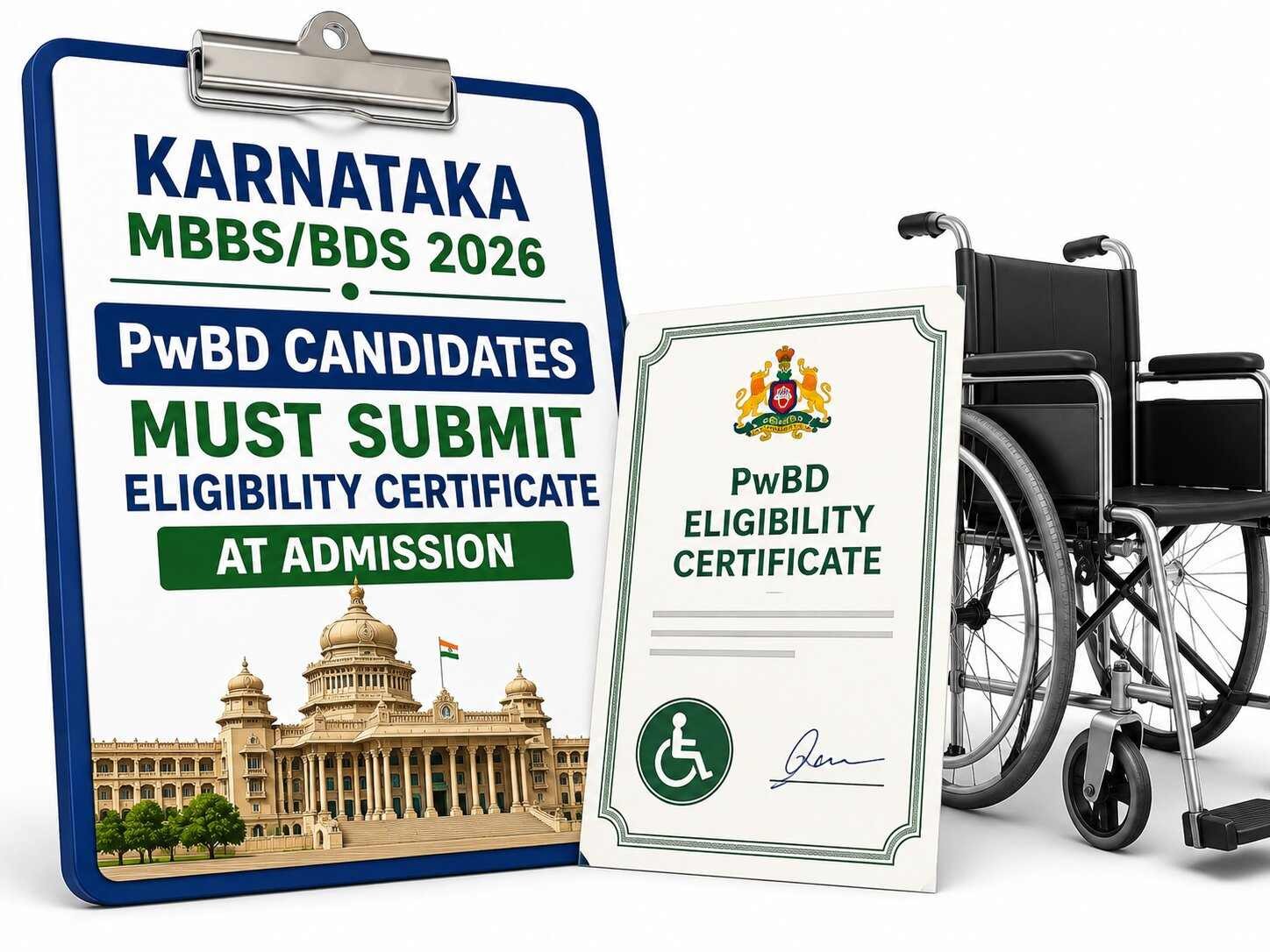
Karnataka MBBS/BDS 2026: PwBD Candidates Must Submit Eligibility Certificate at Admission
The Karnataka Examinations Authority has issued a notice specifically for candidates admitted under the PwBD (Persons with Benchmark Disabilities) category through UGNEET-2026 medical and dental admissions. If you filled your medical seat choices under the earlier CET-2006 reservation rules, there's a new document requirement you need to complete before your admission is finalised — tied to the National Medical Commission's newly framed 2026 guidelines on PwBD assessment.
What's Officially Confirmed
Per KEA's notice dated August 31, 2026, referencing the Director of Medical Education's letter (Ref. U-11011/07/2026-MEC, dated July 30, 2026) conveying the NMC's "Guidelines on Assessment of Persons with Benchmark Disabilities (PwBD) for Admission to the MBBS Course, 2026":
Who this applies to: candidates who filled their medical seat choices under the existing CET-2006 reservation rules for the PwBD category
What's required: submission of an eligibility certificate as per Schedule-II proforma of the NMC's 2026 PwBD Guidelines
When to submit it: at the time of admission to the allotted college — not at an earlier registration stage
How to submit it: through an application to KEA, citing the candidate's KEA application number and NEET roll number
Which forms are required: all candidates must submit Appendix-A; candidates must additionally submit whichever of Appendix-B through Appendix-F applies to their specific disability type
Why This Requirement Exists
This notice sits downstream of a significant national shift in how PwBD eligibility for MBBS admission gets assessed. Following the Supreme Court's judgment in Om Rathod vs. Union of India, the NMC constituted an expert committee to reassess the disability guidelines originally issued by the Medical Council of India in 2019, with the explicit goal of aligning assessment with the Rights of Persons with Disabilities Act, 2016, and more recent Ministry of Social Justice and Empowerment standards. The resulting interim framework — first introduced for the 2025-26 academic year and now carried forward with updates for 2026 — replaces the older, rigid arithmetic disability-percentage threshold with a functional competency approach: rather than asking only "what percentage of disability does this candidate have," the assessment asks "can this candidate meet the actual academic and clinical demands of the MBBS course, with or without assistive devices and reasonable accommodation." Karnataka candidates encountering this Schedule-II requirement are essentially seeing this national framework applied directly to their own admission process.
What the Appendix Forms Actually Ask For
Based on the structure of this framework, the self-certification process works through a general form plus disability-specific affidavits:
Appendix-A (mandatory for every PwBD applicant): a general self-certification covering the candidate's NEET details, UDID number, disability type and percentage, assistive devices used, and a functional competency declaration across five core areas — communication, hearing, dominant hand functionality, understanding/communication, and vision. The candidate declares, item by item, whether they can meet each competency.
Appendix-B (hearing impairment): a detailed affidavit covering which ear is affected, whether a hearing aid or cochlear implant is used, and specific functional declarations — communicating effectively with assistive devices, holding conversations in quiet and noisy environments, understanding verbal instructions, and carrying out phone conversations.
Appendix-C (locomotor disability, upper extremity): covers coordinated upper-body activities specifically — lifting objects overhead, touching the nose with a fingertip, eating independently, grooming, dressing, personal hygiene, holding a glass, managing buttons and zips, and holding a pen to write.
Appendix-D (locomotor disability, lower extremity): covers stability-related functions — bearing weight and standing, walking on plain surfaces, sitting independently, climbing stairs up and down, and turning left or right.
Appendix-E (mental illness, speech disorders, SLD, or ASD): covers communication clarity, listening and responding to speech, following instructions and comprehending medical terminology, and maintaining social interaction, including phone conversations.
Appendix-F (visual impairment): covers which eye is affected, use of low vision aids, and specific mandatory criteria — corrected visual acuity improving to below 40% disability with the aid, field of vision exceeding 40 degrees with the aid, and the aid being hands-free and suitable for everyday use.
Candidates with benchmark disabilities that don't fall into these specific categories — such as blood disorders like haemophilia, thalassemia, and sickle cell disease, or chronic neurological conditions — submit only the general Appendix-A self-certification, without any of the disability-specific affidavits.
How Verification Actually Works
Once submitted, these self-certified affidavits go to a designated medical board for verification, not just a paperwork check. The candidate may need to demonstrate the competencies they've declared to the board's satisfaction. If the board finds a declared competency unsubstantiated based on the candidate's actual performance, it must issue a reasoned decision — not a blanket rejection — explaining why the candidate has been found ineligible. Where a candidate declares a competency deficit, or is unable to demonstrate one or more listed competencies, the board is expected to assess whether the candidate can compensate through alternative functionalities, and take a holistic view of their overall capability to pursue the MBBS course, rather than disqualifying automatically on a single unmet item. Boards may also use standardised tests and tools to evaluate ability, with every decision required to be documented as a reasoned "speaking order" rather than a simple yes-or-no outcome.
The Consequence of a False Declaration
Every appendix in this framework carries the same explicit warning: candidates affirm they possess the essential competencies declared, and are aware that a false declaration may result in revocation of admission. This isn't boilerplate language — given how central these self-certified declarations are to the entire assessment process, accuracy here matters as much as, if not more than, the disability documentation itself.
How This Connects to the Broader National Picture
Karnataka isn't alone in tightening PwBD certification requirements this cycle. West Bengal's own Round 1 admission notice includes comparable provisions — a PwBD candidate who can't produce a valid certificate at physical verification faces either a category edit to non-PwD status (with fallback eligibility for later rounds) or outright seat cancellation, depending on which specific seat they were allotted. Our broader PwBD guide covering certificate requirements and this year's national shift toward functional assessment, along with how PwBD reservation functions across government medical colleges generally, is worth reviewing regardless of which state's specific process you're navigating, since the underlying NMC framework driving all of this is the same nationally.
What Karnataka PwBD Candidates Should Do Right Now
Confirm your UDID card is current and issued by a designated medical authority, since it remains foundational documentation across this entire framework
Complete Appendix-A accurately, and identify which of Appendix-B through F applies to your specific disability before your admission date, not at the admission counter
Be prepared to demonstrate declared competencies to the designated medical board, not just submit paperwork and assume it's sufficient
Submit your application to KEA with your application number and NEET roll number clearly cited, well ahead of your admission date rather than at the last moment
Understand that declaring a competency you cannot actually demonstrate carries real risk — a reasoned board finding of unsubstantiated competency, or a false declaration, can affect your admission directly
If you're also navigating Karnataka's broader UGNEET provisional allotment and objection process this cycle, it's worth tracking both processes together, since your PwBD certification timeline and your general admission timeline are running in parallel, not sequentially.
Key Things to Remember
Karnataka PwBD candidates admitted under CET-2006 rules for UGNEET-2026 medical and dental seats must submit a Schedule-II eligibility certificate, following the NMC's 2026 PwBD assessment guidelines, at the time of admission to their allotted college — Appendix-A is mandatory for everyone, with Appendix-B through F required depending on the specific disability type. This certification isn't a formality; it feeds into a genuine functional-competency assessment by a designated medical board, which can involve demonstrating declared abilities and results in a reasoned decision either way. False declarations carry the explicit risk of admission revocation, making accuracy in these self-certified affidavits just as important as the underlying medical documentation itself.
This information is based on KEA's official notice dated August 31, 2026, and the referenced NMC PwBD assessment framework. Always verify current requirements and the specific Schedule-II proforma directly through KEA (kea.kar.nic.in) before your admission date, since these guidelines continue to be refined nationally.
Article Stats
You Might Also Like
Odisha MBBS & BDS Round 2 Counselling 2026: Provisional Admission Schedule Released

NTA Confirms NEET-UG Will Shift to Computer-Based Test Mode Soon, Nilekani Task Force Drafting Roadmap
West Bengal MBBS & BDS Round 2 Counselling 2026: Merit List Published, Seat Matrix Out, Choice Filling Now Open