 All Articles
JoSAA & CSAB Counselling: Complete Step-by-Step Registration, Choice Filling Strategy, and Seat Allocation Rounds
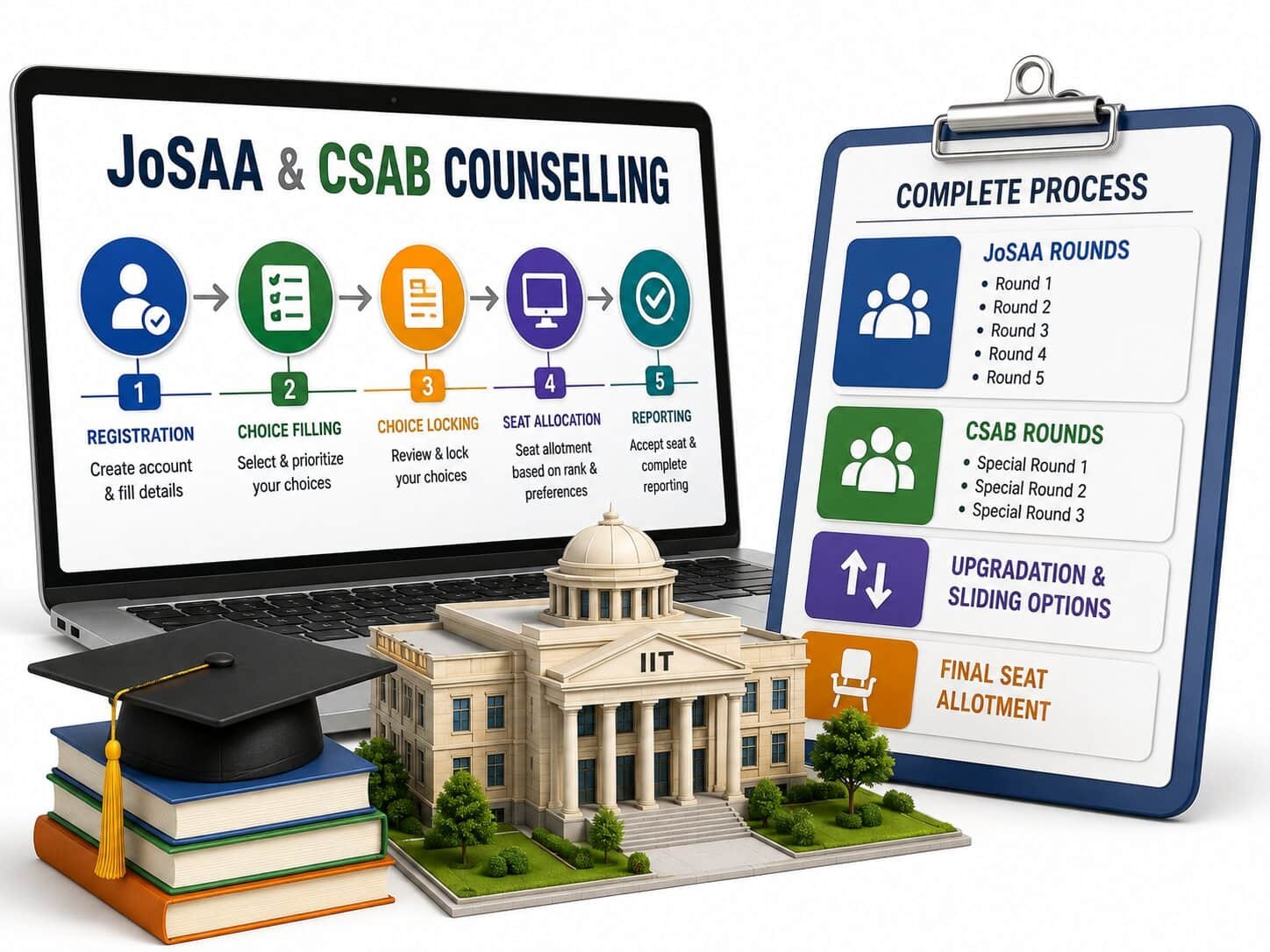
JoSAA counselling is the single gateway through which JEE Main and JEE Advanced ranks convert into an actual seat at an IIT, NIT, IIIT, or GFTI, and the process is considerably more procedural than most first-time candidates expect. A strong rank alone does not guarantee the best possible outcome; how a candidate registers, orders their choices, and responds within each allotment round matters just as much. Understanding this process fully, alongside how the CSAB Special Rounds function once JoSAA concludes, is what separates candidates who convert their rank into an optimal seat from those who leave a better outcome on the table through avoidable procedural mistakes.
Registration: The First Step That Sets Up Everything Else
JoSAA registration typically opens shortly after JEE Advanced results are declared, since candidates need a valid JEE Main rank for NIT, IIIT, and GFTI seats, and a valid JEE Advanced rank for IIT and IISc seats. Registration and choice filling generally run within the same window, and candidates should treat this window as the most consequential phase of the entire counselling process rather than a formality to rush through.
Log in to the official JoSAA portal using JEE Main or JEE Advanced credentials, and complete the registration form with accurate personal, academic, and category details before moving to choice filling
Keep essential documents ready in scanned, upload-ready format well before registration opens, including Class 10 and Class 12 certificates, category certificates where applicable, and JEE scorecards, since delays here can cascade into missed deadlines later
Candidates eligible for both JEE Main-based and JEE Advanced-based seats should register once and will automatically see both categories of institutes available in their choice list, rather than registering separately for each
Registration itself carries no fee, though a seat acceptance fee becomes payable once a seat is actually allotted and accepted in a later round
Choice Filling: Where Strategy Matters More Than Instinct
Choice filling is where most candidates either secure an outcome that matches their genuine preferences or end up with a seat they did not fully intend to accept, simply because the preference order was built carelessly. JoSAA allots seats purely based on rank, category, and the order in which choices were listed, which means a well-thought-out sequence directly shapes the final outcome far more than most candidates initially realise.
List choices in genuine order of preference rather than institute prestige alone, since a strong branch at a slightly lower-ranked institute often serves long-term outcomes better than a weak branch at a more prestigious one
Use previous years' opening and closing ranks, available on the official portal, to build a realistic three-tier list spanning safe, target, and ambitious options, rather than filling the list entirely with reach choices
Fill a genuinely long list rather than a short, cautious one, since an unlisted choice simply removes any possibility of receiving that seat, even if it would have been comfortably within reach
Use the mock seat allotment rounds released during the choice filling window to test how the current list performs, and revise the order based on these results before the final locking deadline
Lock choices manually before the deadline rather than relying on auto-locking, since manually reviewing and confirming the final list reduces the risk of an unintended, hastily saved order becoming permanent
Understanding Freeze, Float, and Slide Before Round 1 Begins
Once seat allotment rounds begin, candidates who receive an offer must respond within a fixed window using one of three options, and misunderstanding these choices is one of the most common and costly mistakes in the entire counselling process. Each of these three responses carries a different implication for whether a candidate stays in the running for a better seat in later rounds or locks in the current one.
Freeze means accepting the allotted seat as final and exiting the counselling process entirely, appropriate when the current allotment already matches genuine preference
Float means accepting the current seat provisionally while remaining open to a better allotment in subsequent rounds, appropriate for candidates who would prefer a higher-ranked choice from their list if it becomes available
Slide means staying within the same institute while remaining open to a better branch at that same institute in later rounds, useful for candidates satisfied with the institute but hoping for branch improvement
Failing to respond within the given window after an allotment typically results in automatic cancellation of that seat, so tracking each round's response deadline closely matters as much as the choice filling itself
Seat Allocation Rounds: What Happens From Round 1 Through the Final Round
JoSAA conducts its seat allocation across multiple rounds, historically running to five or six rounds depending on the year's specific schedule, and each round follows a consistent internal structure of allotment, response, document verification, and fee payment. Understanding this repeating cycle helps candidates anticipate what is expected of them at each stage rather than reacting to each round as a fresh, unfamiliar process.
Round 1 allotment is based purely on the locked choice list, rank, and seat availability, and candidates should expect this round to reflect their preferences most literally, before upgrades from higher-preference candidates begin reshaping availability in later rounds
Each subsequent round reallocates seats vacated by candidates who floated or slid out of them, meaning closing ranks for desirable branches typically loosen somewhat as the rounds progress
Document verification and seat acceptance fee payment must be completed within each round's specific deadline, and candidates who float or slide need to complete this verification only once, since it carries forward across rounds unless the allotment changes significantly
The final round is typically freeze-only for IITs and IISc, meaning no further floating or sliding is possible beyond that point, while candidates in the NIT+ system retain some flexibility to withdraw an accepted seat online up to the last round
Withdrawal rules differ meaningfully between IIT and NIT+ system seats, with IIT and IISc withdrawal generally permitted only up to a specific mid-process round, so candidates should confirm the exact withdrawal window applicable to their situation before assuming flexibility that may not exist
CSAB Special Rounds: What Happens After JoSAA Concludes
Once JoSAA's final round closes, any seats that remain vacant across the NIT+ system, comprising NITs, IIITs, GFTIs, and a small number of other participating institutes, move into a separate counselling process run by the Central Seat Allocation Board. This is a genuinely distinct process from JoSAA, and candidates should not assume any continuity between the two.
CSAB Special Rounds do not include IIT or IISc seats, since these institutes have no equivalent post-JoSAA vacancy process
Fresh registration, fee payment, and choice filling are compulsory for CSAB, since choices submitted during JoSAA do not carry forward automatically into this separate process
Candidates who received a JoSAA seat but wish to try for a better outcome through CSAB should confirm the specific rules for retaining their JoSAA-allotted seat while participating in CSAB rounds, since the two processes interact in ways that vary by candidate type
CSAB typically runs two special rounds, following the same underlying model of allotment, response, verification, and fee payment used in JoSAA, so the procedural discipline built up during JoSAA transfers directly to this stage
A vacancy matrix specific to CSAB is published after JoSAA concludes, and candidates should build their CSAB preference list against this fresh matrix rather than assuming it mirrors JoSAA's earlier availability
Common Mistakes Worth Avoiding Across Both Processes
A recurring pattern across both JoSAA and CSAB counselling is candidates losing a better outcome not due to their rank, but due to procedural missteps that were entirely avoidable with better preparation and attentiveness during the actual counselling window.
Filling too short a choice list, which needlessly narrows the range of possible outcomes even when a rank would comfortably support a longer, more ambitious list
Missing a round's response deadline due to not tracking the notification closely, resulting in automatic cancellation of an otherwise secured seat
Reusing an old JoSAA-style choice order directly in CSAB without adjusting for the fresh vacancy matrix, since seat availability at this stage differs meaningfully from the original JoSAA rounds
Treating mock allotment results as final rather than using them as a genuine tool to revise and improve the choice list before the actual locking deadline
Candidates evaluating institute options within their expected rank range often find it useful to cross-check national-level choices against strong state-level alternatives as well, and reviewing top government and private engineering colleges accepting WBJEE scores offers a useful parallel benchmark, particularly for candidates weighing a JoSAA or CSAB outcome against a strong state counselling option as a backup. Understanding how JEE Main marks and percentile actually convert into rank earlier in the preparation timeline also helps set realistic expectations well before choice filling begins, rather than discovering the gap between expectation and reality only once counselling is already underway.
The Bottom Line
JoSAA and CSAB counselling reward candidates who treat the process with the same discipline as exam preparation itself, rather than assuming a strong rank alone will handle the rest. A carefully sequenced choice list, a clear understanding of Freeze, Float, and Slide, and close attention to each round's specific deadlines together determine whether a rank converts into the best available outcome or into a seat that could have been meaningfully better with more careful navigation of the process.
Article Stats