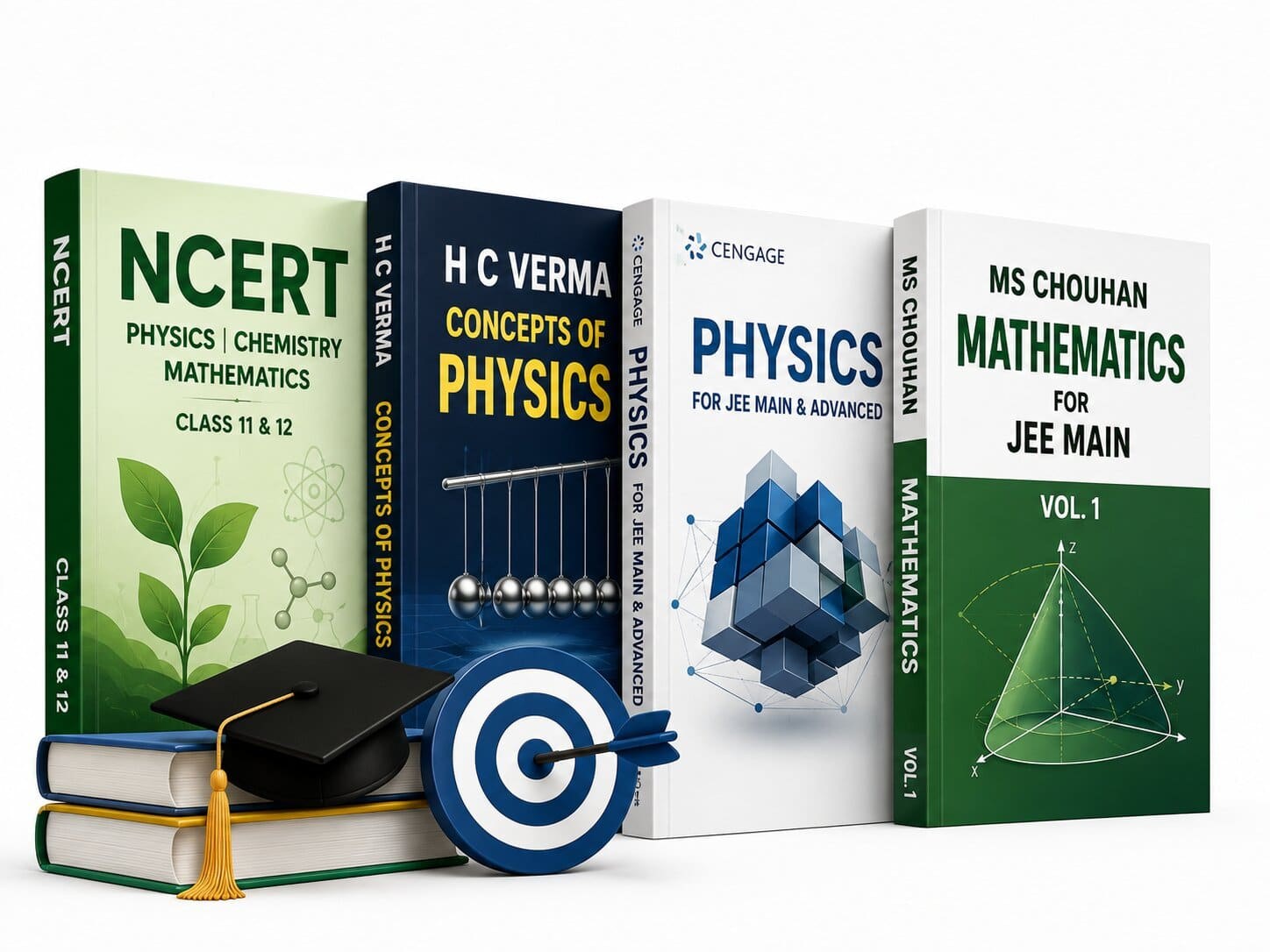
Ask a hundred JEE Main toppers which books they used, and the same handful of names come up repeatedly. Yet simply owning these books changes nothing; what separates a candidate who benefits from them and one who doesn't is knowing exactly which book serves which purpose, and in what sequence they should actually be used. NCERT, HC Verma, Cengage, and MS Chouhan are not interchangeable options to pick one from; they serve four distinct roles in a well-structured preparation plan.
NCERT: The Non-Negotiable Foundation, Not a Formality
NCERT textbooks get treated by many candidates as something to skim through quickly before moving on to "real" preparation material, and this is a costly misjudgment. A meaningful share of JEE Main questions, particularly in Chemistry, draw directly from NCERT's own phrasing and examples, which makes a careless reading of these textbooks a genuine, avoidable source of lost marks.
Physics and Mathematics NCERT chapters build the conceptual base that every advanced problem eventually rests on, and skipping straight to harder reference books without this foundation tends to produce shaky, formula-dependent problem-solving
Chemistry, especially Inorganic Chemistry, is where NCERT matters most directly, since several JEE Main questions are drawn almost verbatim from textbook lines, exceptions, and examples
NCERT exercises and in-text examples should be solved fully at least once before moving to reference books, rather than only being read passively
Revisiting NCERT during final revision, particularly for Chemistry, often yields a better return on time than another pass through a bulkier reference book at that late stage
HC Verma: Building Genuine Physics Intuition
HC Verma's Concepts of Physics remains one of the most consistently recommended Physics resources for JEE Main, not because its problems mirror the exam's exact format, but because it builds the kind of first-principles thinking that makes unfamiliar numerical problems solvable under exam pressure. Candidates who rely purely on formula-plugging tend to struggle precisely on the twisted, conceptually layered problems HC Verma is known for.
Use HC Verma primarily during the concept-building phase of preparation, working through both the theory sections and the worked examples before attempting the exercise problems
The book's problems are generally more conceptually demanding than typical JEE Main questions, which makes it excellent for building depth even though direct question-format overlap with the actual exam is limited
Prioritise the objective-type and short-answer sections for exam-specific practice, while treating the subjective problems as depth-building exercises rather than direct exam simulation
Pair HC Verma's conceptual grounding with timed practice from previous years' JEE Main papers, since intuition alone does not build the speed the actual exam demands
Cengage: Structured, Exam-Aligned Practice Across Subjects
The Cengage series, commonly used across Physics, Chemistry, and Mathematics, is built specifically around the JEE question format, making it a natural bridge between conceptual study and exam-ready practice. Its chapter-wise structure, with graded difficulty levels, suits candidates who have already built a conceptual base through NCERT and subject-specific books and are ready to convert that understanding into exam accuracy and speed.
Use Cengage after conceptual clarity has been established through NCERT and subject-specific books, rather than as a first point of contact with a new chapter
The graded exercise structure, typically moving from basic to advanced difficulty within each chapter, works well for building both accuracy and gradual speed
Cengage's Mathematics volumes are particularly well regarded for Algebra and Calculus, chapters that carry heavy weightage in JEE Main and reward the kind of structured, repetitive practice this series offers
Avoid attempting the most advanced problems in each chapter too early, since these are often calibrated closer to JEE Advanced difficulty and can be discouraging before the fundamentals are fully solid
MS Chouhan: Sharpening Organic Chemistry Specifically
MS Chouhan's Organic Chemistry reference is widely used for one specific purpose: converting a conceptual understanding of reaction mechanisms into fast, reliable problem-solving speed. Organic Chemistry is unusual among JEE Main topics in that surface-level memorisation of reactions performs poorly against the exam's tendency to test mechanism-based reasoning, and this is precisely where MS Chouhan's problem sets add value.
Use this book specifically for Organic Chemistry practice once the underlying mechanisms have already been studied through NCERT and classroom or coaching material
The problem sets are organised to build pattern recognition across reaction types, which pays off directly in the speed needed to handle Organic Chemistry questions within JEE Main's time constraints
Treat this as a practice and drilling resource rather than a primary learning text, since it assumes conceptual familiarity with mechanisms rather than teaching them from scratch
Regular, spaced revisits to previously solved problem sets in this book help reinforce reaction pattern recognition better than moving through it only once in a linear fashion
Sequencing These Resources Into One Coherent Plan
The real value of these four resources comes from using them in the right sequence rather than working through all of them simultaneously from day one. A candidate who tries to juggle NCERT, HC Verma, Cengage, and MS Chouhan all at once for every chapter often ends up with fragmented, shallow coverage across all four rather than genuine depth in any of them.
Start every new chapter with NCERT to build the conceptual foundation, then move to subject-specific depth-building resources like HC Verma for Physics or classroom material for Chemistry mechanisms
Bring in Cengage once basic conceptual clarity is established, using its graded exercises to build exam-aligned speed and accuracy across Physics, Chemistry, and Mathematics
Layer in MS Chouhan specifically for Organic Chemistry once mechanisms are understood, using it as a dedicated drilling resource rather than a first-pass learning text
Reserve the final revision months for previous years' JEE Main papers and personal error logs rather than continuing to work through fresh material from any of these books, since consolidation matters more than new coverage this close to the exam
Choosing the right books matters, but knowing how a strong percentile actually converts into a realistic college outcome matters just as much, and reviewing how JEE Main marks and percentile translate into rank and admission chances helps anchor book-based preparation to a concrete target rather than open-ended studying. Candidates preparing for both JEE Main and WBJEE in parallel should also account for how differently the two exams weight their subjects, since WBJEE's heavier emphasis on Mathematics may call for a different balance of time across these same resources.
The Bottom Line
NCERT builds the non-negotiable foundation, HC Verma develops genuine Physics intuition, Cengage converts conceptual clarity into exam-aligned speed and accuracy, and MS Chouhan sharpens Organic Chemistry specifically once mechanisms are understood. None of these four resources substitutes for the others, and the candidates who benefit most from them are the ones who use each at the right stage of preparation rather than treating all four as one undifferentiated stack of books to work through simultaneously.
Article Stats