 All Articles
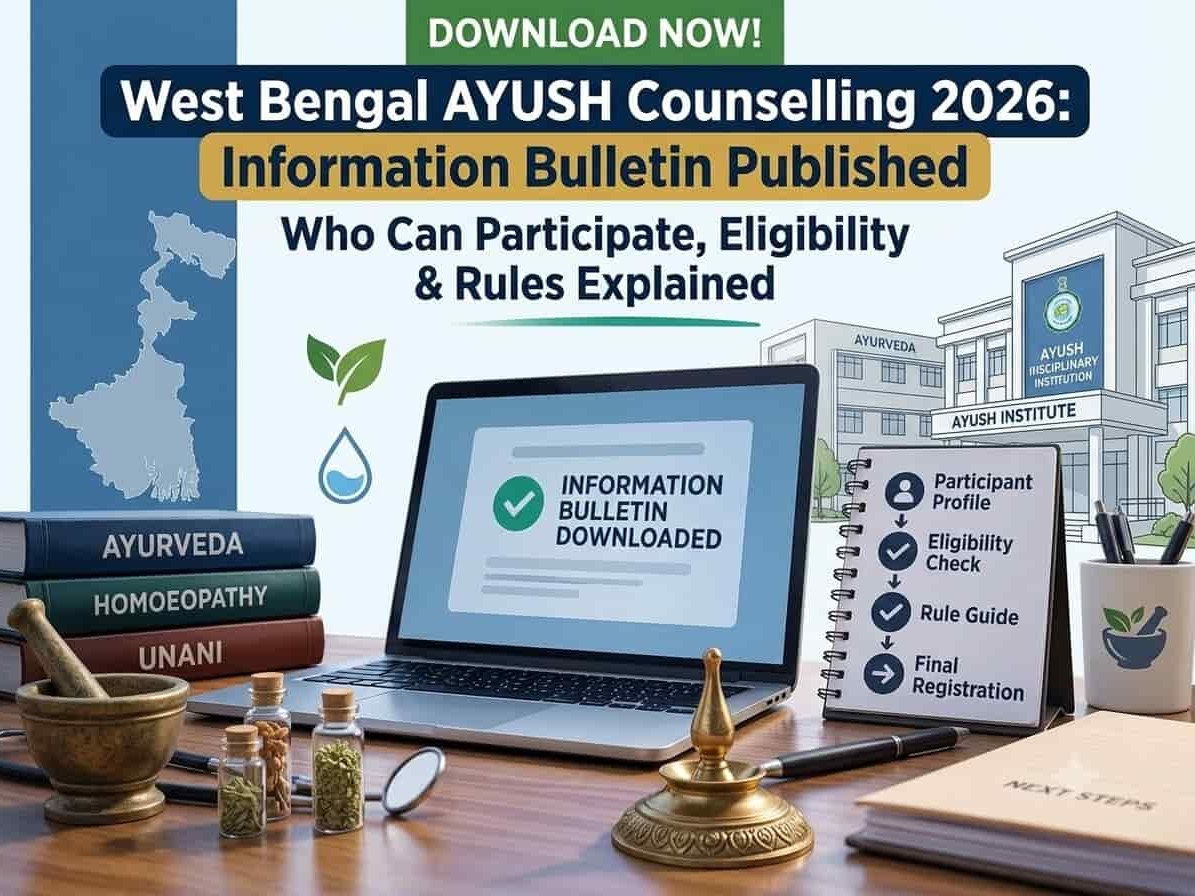
West Bengal AYUSH Counselling 2026 Information Bulletin Published: Who Can Participate, Eligibility & Rules Explained
The West Bengal Medical Counselling Committee (WBMCC) has published the Notice cum Information Bulletin for UG AYUSH Counselling 2026, formally kicking off the admission process for BAMS, BHMS, BUMS, and BNYS courses in the state. Here's a complete breakdown of who can participate, the reservation categories in play, and the rules and regulations every AYUSH aspirant in West Bengal needs to know.
What's Been Announced
WBMCC, functioning under the Directorate of Medical Education, Government of West Bengal, has released the UG AYUSH Counselling Notice cum Information Bulletin 2026 on its official portal, wbmcc.nic.in. This bulletin governs admission to Under-Graduate AYUSH courses - BAMS (Bachelor of Ayurvedic Medicine and Surgery), BHMS (Bachelor of Homoeopathic Medicine and Surgery), BUMS (Bachelor of Unani Medicine and Surgery), and BNYS (Bachelor of Naturopathy and Yogic Sciences) - across West Bengal's participating Government and Private AYUSH colleges.
The bulletin covers three distinct seat pools:
State Quota seats in Government AYUSH Colleges.
State Quota and Management Quota seats in Private AYUSH Colleges.
All India Quota seats in Private AYUSH Colleges.
Who Can Participate in WB AYUSH Counselling 2026
To be eligible for West Bengal UG AYUSH Counselling 2026, candidates must:
Appear and qualify in NEET-UG 2026, conducted by the National Testing Agency (NTA) - this is the mandatory entry point for all AYUSH admissions, whether State Quota, Management Quota, or All India Quota.
Meet the minimum qualifying percentile prescribed for their category — generally 50th percentile for Unreserved (UR) and EWS candidates, 45th percentile for General PwD, and 40th percentile for SC, ST, and OBC candidates (including PwD candidates within these categories).
Fulfil the domicile requirement for West Bengal, if applying for the 85% State Quota seats. Non-domicile candidates are not eligible to compete for State Quota seats but can still participate for Management Quota seats in Private AYUSH Colleges, where allotment runs purely on NEET-UG merit without any domicile restriction.
Meet the age and academic eligibility set out in the bulletin, including having passed Class 12 with Physics, Chemistry, Biology/Biotechnology, and English from a recognised board.
Reservation Categories Under WBMCC AYUSH Counselling
WBMCC prepares its AYUSH merit lists on the basis of inter se merit among six status groups:
Un-Reserved (UR)
Economically Weaker Section (EWS)
Other Backward Classes (OBC) — further split into OBC-A and OBC-B, a categorisation unique to West Bengal
Scheduled Caste (SC)
Scheduled Tribe (ST)
Person with Disability (PwD)
A few rules candidates frequently overlook:
Reservation benefits under SC, ST, OBC-A, OBC-B, and EWS apply only to candidates domiciled in West Bengal with a valid, state-issued certificate. A reserved-category certificate from another state does not carry reservation benefit here — such candidates are treated as Unreserved (UR) for West Bengal State Quota purposes, though they remain eligible to compete for UR seats if they clear the UR qualifying percentile.
OBC-A and OBC-B candidates must submit a Non-Creamy Layer (NCL) certificate; candidates falling within the creamy layer are treated as Unreserved.
Category status generally cannot be freshly declared or changed at the WBMCC stage — it is carried forward from the candidate's original NEET-UG 2026 application with NTA, so candidates should verify their NTA application details are accurate well before WBMCC registration opens.
Management Quota seats in Private AYUSH Colleges carry no caste or PwD reservation — allotment there is based purely on NEET-UG 2026 merit.
Key Rules and Regulations Candidates Must Follow
Registration and counselling fee: As per WBMCC's standard AYUSH fee structure, Unreserved and EWS candidates typically pay a higher non-refundable registration fee than SC/ST/OBC/PwD candidates — candidates should confirm the exact 2026 fee slab in the published bulletin before proceeding.
Domicile proof: State Quota eligibility requires a valid West Bengal domicile certificate issued by a competent authority, typically the District Magistrate (DM)/Additional District Magistrate (ADM) or Sub-Divisional Officer (SDO)/Block Development Officer (BDO). Certificates from other issuing authorities may not be accepted at document verification.
Choice filling: Candidates are permitted to fill as many college and course choices as they wish - a longer, well-considered preference list improves the chances of favourable allotment across rounds.
Category certificate verification: Caste and category certificates are examined by officers nominated by the Backward Class Welfare Department (BCWD), Government of West Bengal, both at the pre-choice-filling stage and again at post-allotment admission.
Merit-based allotment only: Seats are allotted strictly on the basis of NEET-UG 2026 rank within each inter se merit category - there is no interview or additional qualifying test.
Multiple rounds: WB AYUSH Counselling typically runs across Round 1, Round 2, and further rounds (including a stray vacancy round where required), with a fresh seat matrix and choice-filling opportunity in each round.
Participating Courses and Colleges
WB AYUSH Counselling 2026 covers admissions to Government and Private AYUSH colleges across the state offering BAMS, BHMS, BUMS, and BNYS programmes. In recent cycles, the participating list has included institutions such as JB Roy State Ayurvedic Medical College and Hospital, Raghunath Ayurved Mahavidyalaya and Hospital, and The Calcutta Homoeopathic Medical College and Hospital, among others — candidates should check the final list of participating colleges and their seat matrix published alongside the bulletin, since it can vary year to year.
What Candidates Should Do Now
Read the full Notice cum Information Bulletin 2026 on wbmcc.nic.in carefully before registering, since it contains the authoritative eligibility criteria, fee structure, and document checklist for this cycle.
Confirm your NEET-UG 2026 category and percentile meet the qualifying threshold for AYUSH admission.
Arrange your West Bengal domicile certificate early, from a recognised issuing authority, if you intend to compete for State Quota seats.
Verify your reservation category details from your original NTA NEET-UG application, since this cannot typically be changed at the WBMCC stage.
Watch for the registration window, choice-filling schedule, and seat matrix, which WBMCC will notify separately following the bulletin.
Key Things to Remember
WBMCC has published the UG AYUSH Counselling Notice cum Information Bulletin 2026 on wbmcc.nic.in, covering BAMS, BHMS, BUMS, and BNYS admissions.
Eligibility requires qualifying NEET-UG 2026 and meeting the category-wise minimum percentile.
Seats are allotted through inter se merit lists across UR, EWS, OBC-A, OBC-B, SC, ST, and PwD categories.
State Quota seats require West Bengal domicile; Management Quota seats do not, and are allotted purely on NEET-UG merit.
Reservation category is carried forward from the NTA NEET-UG application and generally cannot be changed during WBMCC registration.
Candidates should track wbmcc.nic.in regularly for the registration schedule, seat matrix, and further notices tied to this bulletin.
This article is based on the UG AYUSH Counselling Notice cum Information Bulletin 2026 published by the West Bengal Medical Counselling Committee (WBMCC) on wbmcc.nic.in. Candidates should verify the complete eligibility criteria, fee structure, and schedule directly from the official bulletin and portal before registering.
Article Stats
You Might Also Like
What Is the MS Course? A Complete Guide to Introduction, Eligibility, NEET PG Counselling and Preparation
What Is the MD Course? A Complete Guide to Introduction, Eligibility, NEET PG Counselling and Preparation
Tripura MBBS BDS Round 3 Re-Revised Schedule 2026: Choice Filling, Merit List, Allotment and Admission Dates