 All Articles
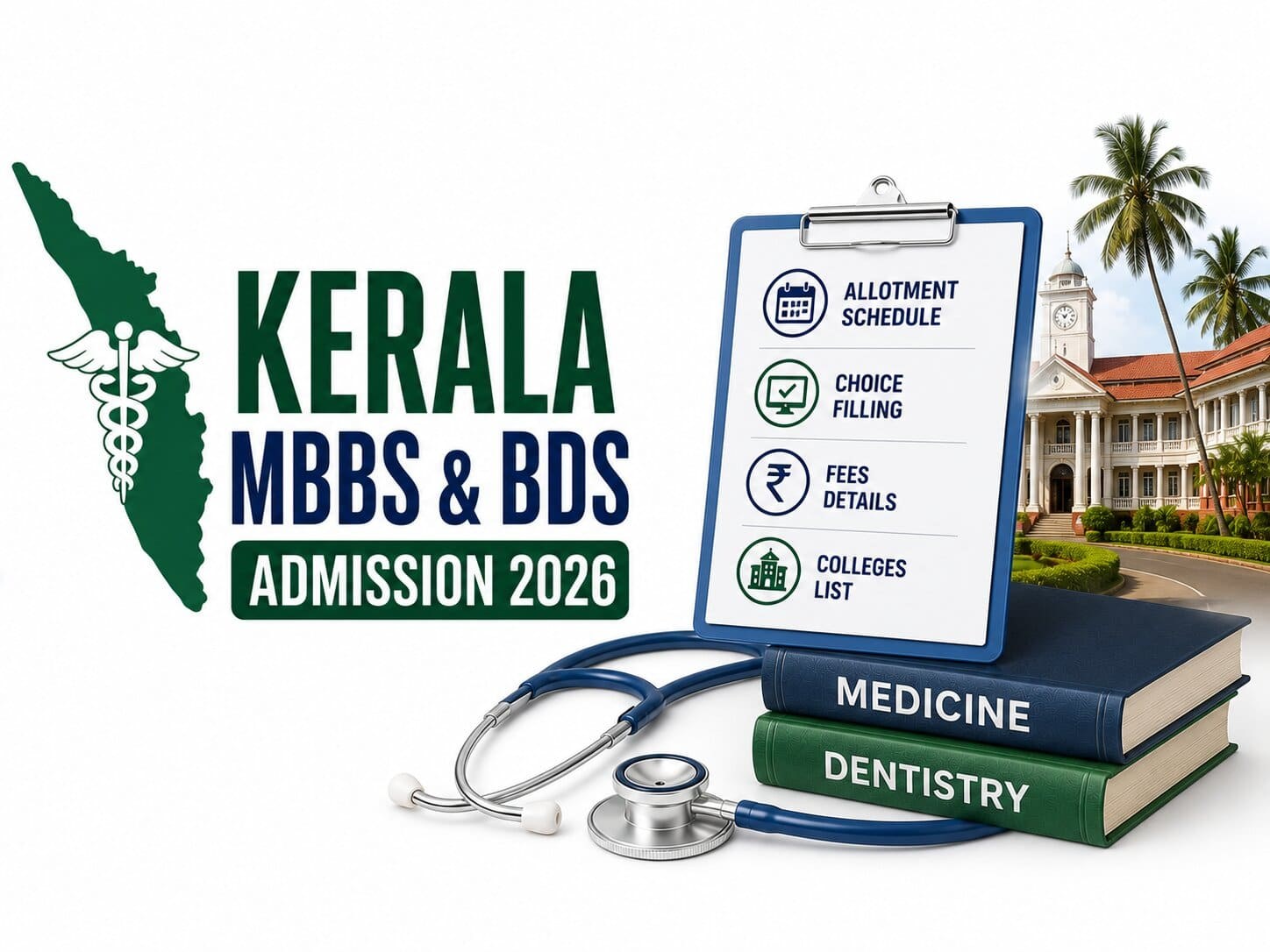
Kerala MBBS & BDS Admission 2026: Allotment Schedule, Choice Filling, Fees & Colleges
The Commissioner for Entrance Examinations, Kerala, has officially released the KEAM-2026 notification inviting online options for MBBS and BDS admission, and the first phase allotment - covering everything except NRI quota seats - is already underway. This guide walks through the confirmed schedule, exactly how option registration and allotment work, the full fee structure across every participating college, and how Kerala's detailed reservation system applies, based directly on CEE's official notification.
What CEE Kerala Counselling Covers
Kerala's MBBS and BDS admission is conducted by the Commissioner for Entrance Examinations through a centralised allotment process covering government medical and dental colleges, along with self-financing medical and dental colleges across the state. This first phase covers General, State Merit, and reservation-category seats; NRI quota allotment specifically commences only from Round 2 onward, not this phase. The remaining 15% All India Quota seats, along with 100% of seats at central institutions, are handled entirely separately through MCC's own national counselling process, which candidates need to track in parallel.
The Confirmed Allotment Schedule
August 15, 2026: Website opens for registration to MBBS/BDS courses
August 20, 2026, 12:00 Noon: Closure of online option registration facility
August 21, 2026: First Phase Provisional Allotment Publication
August 22, 2026: First Phase Final Allotment Publication
August 23 to August 28, 2026, 4:00 PM (excluding August 26): Candidates who receive allotment must remit the fee shown in their allotment memo and take admission
August 28, 2026, 5:00 PM: College authorities approve and submit the list of admitted candidates through OAMS
This schedule is explicitly marked tentative by CEE and is subject to change based on MCC's own counselling schedule, since the two processes need to stay reasonably coordinated.
A Critical Rule Most Candidates Miss: There's No Second Chance to Add Choices
CEE's notification is direct about this, and it's worth repeating clearly: there is no provision for fresh option registration in the next phase of the centralised allotment process, unless new colleges are added to the list. Candidates are explicitly advised to register every course and college combination they would genuinely accept in this very first phase, rather than holding back options for later. Filing a narrow, cautious list now on the assumption you can expand it later is a genuine risk under this specific rule.
Registering Options and How Allotment Actually Works
Candidates who appear in the State Medical Rank List published by CEE can register their options through www.cee.kerala.gov.in. Allotment is based entirely on the options registered, matched against rank and seat availability. A few procedural specifics worth knowing:
Candidates whose rank list results have been withheld for any reason can still register options online, but those options won't be considered for allotment unless the candidate clears the relevant defect and gets their rank released before 3 PM on August 19, 2026
All Indian candidates, regardless of domicile, can register options for the 15% AIQ seats available within self-financing colleges specifically
Candidates seeking minority quota seats in self-financing medical or dental colleges must separately register options for those specific seats through the same portal within the stipulated time
Reservation Structure: The Full Breakdown
Kerala's reservation framework for this admission cycle is considerably more detailed than most other states' systems, and understanding the specific sub-categories matters for accurately gauging your own competitiveness:
State Merit (SM): 50%
Economically Weaker Sections (EWS): 10%
Socially and Educationally Backward Classes (SEBC): 30% total, broken down further into Ezhava (9%), Muslim (8%), Other Backward Hindu (3%), Latin Catholic and Anglo Indian (3%), Dheevara and related communities (2%), Viswakarma and related communities (2%), Kusavan and related communities (1%), Other Backward Christian (1%), and Kudumbi (1%)
Scheduled Castes and Scheduled Tribes: 10% total, split as SC (8%) and ST (2%)
Two government colleges follow entirely different reservation patterns worth knowing specifically if either is on your radar. Government Medical College, Palakkad (Institute of Integrated Medical Sciences) follows SC 70%, ST 2%, General Merit 13%, and AIQ 15%, per a 2015 government order. Government Medical College, Kollam follows State Quota 50%, seats reserved for wards of insured persons under the Employees' State Insurance Corporation at 35% (not allotted by CEE), and AIQ 15%, per a 2017 order. Candidates evaluating either institution should factor these very different reservation structures into their expectations directly, rather than assuming the standard statewide breakdown applies uniformly everywhere.
For PwBD candidates specifically, the broader national shift toward competency-based eligibility assessment this cycle applies in comparable form across most states, and how PwBD reservation functions within government medical colleges generally is worth reviewing alongside Kerala's specific category structure above.
Government College Fees
Government college fees in Kerala remain remarkably affordable, and the notification confirms exact figures for this cycle:
MBBS at Government Medical Colleges: ₹23,150 total
BDS at Government Dental Colleges: ₹20,840 total
These figures apply uniformly across all participating government institutions, making government seats by far the most cost-effective route into Kerala's medical education system.
Self-Financing Medical College Fees
Self-financing college fees vary by institution but sit within a fairly consistent band. General category (85% seats) annual fees run from approximately ₹8.10 lakh at the lower end to around ₹9.31 lakh at the higher end, while NRI category (15% seats) fees run largely between ₹21.65 lakh and ₹22.74 lakh annually across nearly every participating institution. A few reference points across the twenty participating self-financing medical colleges: Kerala Medical College, Palakkad and Sree Gokulam Medical College, Thiruvananthapuram sit at the more affordable end around ₹8.10 lakh General fee, while Dr. Moopen's Medical College, Wayanad runs higher at approximately ₹9.31 lakh. It's worth noting explicitly that these fees are provisional and subject to final orders from the Fee Regulatory Committee, state government, or the courts — a genuinely live issue this cycle given the ongoing developments around Kerala's MBBS fee structure and duration rules, where a recent government order and a pending High Court case are still shaping what colleges can ultimately charge. CEE's own notification confirms that if the 2026-27 fee eventually gets fixed higher than what candidates provisionally pay now, based on the 2025-26 rate, candidates will be liable to pay the balance later.
Self-Financing Dental College Fees
Dental college fees follow a similar general-versus-NRI split, though at a considerably lower band than medical: General category fees run at approximately ₹3.47 lakh annually, with NRI category fees around ₹6.30 lakh. Pushpagiri College of Dental Science, Thiruvalla, is a specific exception with slightly higher fees at approximately ₹3.68 lakh General and ₹6.66 lakh NRI.
Option Registration Fee and Refund Rules
Registering options requires paying a fee to CEE, with the exact amount and refund treatment depending on category and eventual outcome:
Standard registration fee: ₹5,000
Reduced fee for SC/ST/OEC candidates and specific government-order beneficiaries (including those from Juvenile Home, Nirbhaya Home, and Sree Chitra Home): ₹500
If allotted a government college seat: the registration fee is carried over and adjusted against the tuition fee for the allotted course
If not allotted any seat: the registration fee is refunded in full
If allotted a private self-financing college seat: the registration fee is refunded after the closing date of admission, provided the candidate has actually taken admission
If a candidate doesn't join within the stipulated time after allotment, or quits after taking admission: the fee is treated as a penalty and is not refunded
The Full List of Participating Colleges
Government Medical Colleges
Fourteen government medical colleges participate in this phase: Government T D Medical College, Alappuzha; Government Medical College, Ernakulam; Government Medical College, Kozhikode; Government Medical College, Parippally, Kollam; Government Medical College, Kottayam; Government Medical College, Manjeri, Malappuram; Government Medical College, Palakkad; Government Medical College, Thrissur; Government Medical College, Thiruvananthapuram; Government Medical College, Pariyaram, Kannur; Government Medical College, Idukki; Government Medical College, Konni; Government Medical College, Kasaragod; and Government Medical College, Wayanad. Allotment to the Palakkad and Thiruvananthapuram institutions specifically follows university affiliation and government order rules rather than the standard process.
Self-Financing Medical Colleges
Twenty self-financing medical colleges participate this phase, spanning across the state: Amala Institute of Medical Sciences (Thrissur), Azeezia Institute of Medical Science and Research (Kollam), Believers Church Medical College Hospital (Thiruvalla), MES Medical College (Malappuram), Sree Gokulam Medical College & Research Foundation (Thiruvananthapuram), Jubilee Mission Medical College & Research Institute (Thrissur), PK Das Institute of Medical Sciences (Palakkad), Malankara Orthodox Syrian Church Medical College (Ernakulam), Malabar Medical College Hospital & Research Centre (Kozhikode), Pushpagiri Institute of Medical Science & Research Centre (Thiruvalla), Travancore Medical College (Kollam), KMCT Medical College (Kozhikode), Sree Narayana Institute of Medical Sciences (Ernakulam), Dr. Somervell Memorial CSI Medical College (Thiruvananthapuram), Mount Zion Medical College (Pathanamthitta), Al-Azhar Medical College & Super Speciality Hospital (Idukki), Dr. Moopen's Medical College Hospital (Wayanad), SUT Academy of Medical Sciences (Thiruvananthapuram), Karuna Medical College (Palakkad), and Kerala Medical College (Palakkad).
Government and Self-Financing Dental Colleges
Six government dental colleges participate: Government Dental College at Alappuzha, Kozhikode, Kottayam, Thrissur, Thiruvananthapuram, and Pariyaram (Kannur). Seventeen self-financing dental colleges round out the dental seat pool, spread across Ernakulam, Kozhikode, Malappuram, Thiruvananthapuram, Thrissur, Palakkad, and Kollam districts.
Fee Payment Rules by College Type
Self-financing college allottees pay the fee directly to the college as per the allotment memo
Government college allottees pay the complete fee directly to CEE, not the institution
SC/ST/OEC candidates and specific government-order beneficiaries are exempt from remitting a token deposit to CEE, though if allotted a minority quota seat in a self-financing college instead, they lose this concession and must pay the prescribed fee in full
Building a Realistic Choice List Under This Phase's Rules
Given that this phase offers no guaranteed second opportunity to add fresh options, the research that goes into your choice list matters more here than in counselling systems that allow ongoing revision across rounds. Understanding how your NEET score converts into a realistic estimated rank before finalising options changes how targeted this research can be, and the broader framework behind choosing the right medical college based on genuine fit rather than reputation alone applies directly to Kerala's mix of government and self-financing options. Now that this year's NEET UG results and cutoffs are public, benchmarking your score against current data rather than older figures gives a considerably more accurate read on where you stand within Kerala's specific rank list.
Why Registering for Both AIQ and Kerala's State Process Makes Sense
Candidates eligible for both routes should treat MCC's All India Quota counselling and CEE Kerala's state process as two parallel, independent applicant pools rather than one combined system, or a backup-only option. Since options for this Kerala phase can't easily be revised later, having your AIQ registration and choices sorted on a similar timeline avoids one process falling behind the other purely due to scheduling oversight.
Don't Assume This Phase Is the Only Opportunity
While this specific phase offers no fresh option registration without new colleges being added, Kerala's overall counselling structure still includes further rounds beyond this one, including scope for stray vacancies as seats free up. The same underlying logic that applies broadly across state counselling systems holds here too — seats unfilled after early rounds can resurface later, even where, as in this specific phase, the rules around adding fresh choices are more restrictive than in other states.
How Kerala's Process Compares to Other States This Cycle
Every state is running its 2026 counselling on its own independent timeline and rule structure, and Kerala's no-fresh-options rule this phase is a good example of how much these processes can differ procedurally, not just by date. West Bengal's WBMCC framework and its confirmed Round 1 schedule run on an entirely separate calendar and rule set, as do Jharkhand's revised counselling dates and Karnataka's own registration process. For broader context on how competition varies state to state, this breakdown of which states are producing the highest numbers of qualified candidates nationally is a useful reference point, alongside an awareness that seat capacity itself shifts meaningfully from cycle to cycle across nearly every state.
Documents and Preparation Checklist
Having every required document scanned, verified, and ready before the option registration window closes on August 20 saves genuine time and avoids last-minute stress, particularly given how little room this specific phase leaves for correction afterward. This general checklist of documents required for NEET counselling applies broadly across state processes, including Kerala's, even though CEE's specific category and reservation documentation adds a few state-specific requirements beyond the standard list.
Planning for Cost Support
Given the meaningful gap between government fees (a few thousand rupees) and self-financing fees (running into several lakhs annually), checking scholarship eligibility early is worth doing regardless of which quota you expect to fall under. Options like the Swami Vivekananda Merit-cum-Means Scholarship and the National Scholarship Portal are worth reviewing before finalising options weighted toward higher-fee self-financing colleges, particularly given that this year's self-financing fees remain provisional pending final orders.
Key Things to Remember
CEE Kerala's first phase MBBS and BDS allotment for 2026-27 runs option registration through August 20 (12:00 Noon), with provisional allotment on August 21, final allotment on August 22, and admission fee payment and joining between August 23 and August 28. This phase excludes NRI quota seats, which begin allotment only from Round 2. There is no guaranteed opportunity to add fresh options in the next phase unless new colleges are added, making a comprehensive, carefully researched choice list essential this time around, not optional. Government college fees remain extremely affordable at roughly ₹23,150 for MBBS and ₹20,840 for BDS, while self-financing fees run into several lakhs annually and remain provisional pending final regulatory and court orders. Kerala's detailed reservation structure, including two colleges with entirely non-standard reservation patterns, is worth understanding precisely rather than assuming a single statewide formula applies everywhere.
This guide is based on CEE Kerala's official KEAM-2026 notification dated August 15, 2026. Always verify current dates, fees, and requirements directly at www.cee.kerala.gov.in, since this schedule is explicitly tentative and subject to change based on MCC's counselling timeline and final regulatory or court orders on fees.
Article Stats
You Might Also Like
What Is the MS Course? A Complete Guide to Introduction, Eligibility, NEET PG Counselling and Preparation

What Is the MD Course? A Complete Guide to Introduction, Eligibility, NEET PG Counselling and Preparation
Tripura MBBS BDS Round 3 Re-Revised Schedule 2026: Choice Filling, Merit List, Allotment and Admission Dates